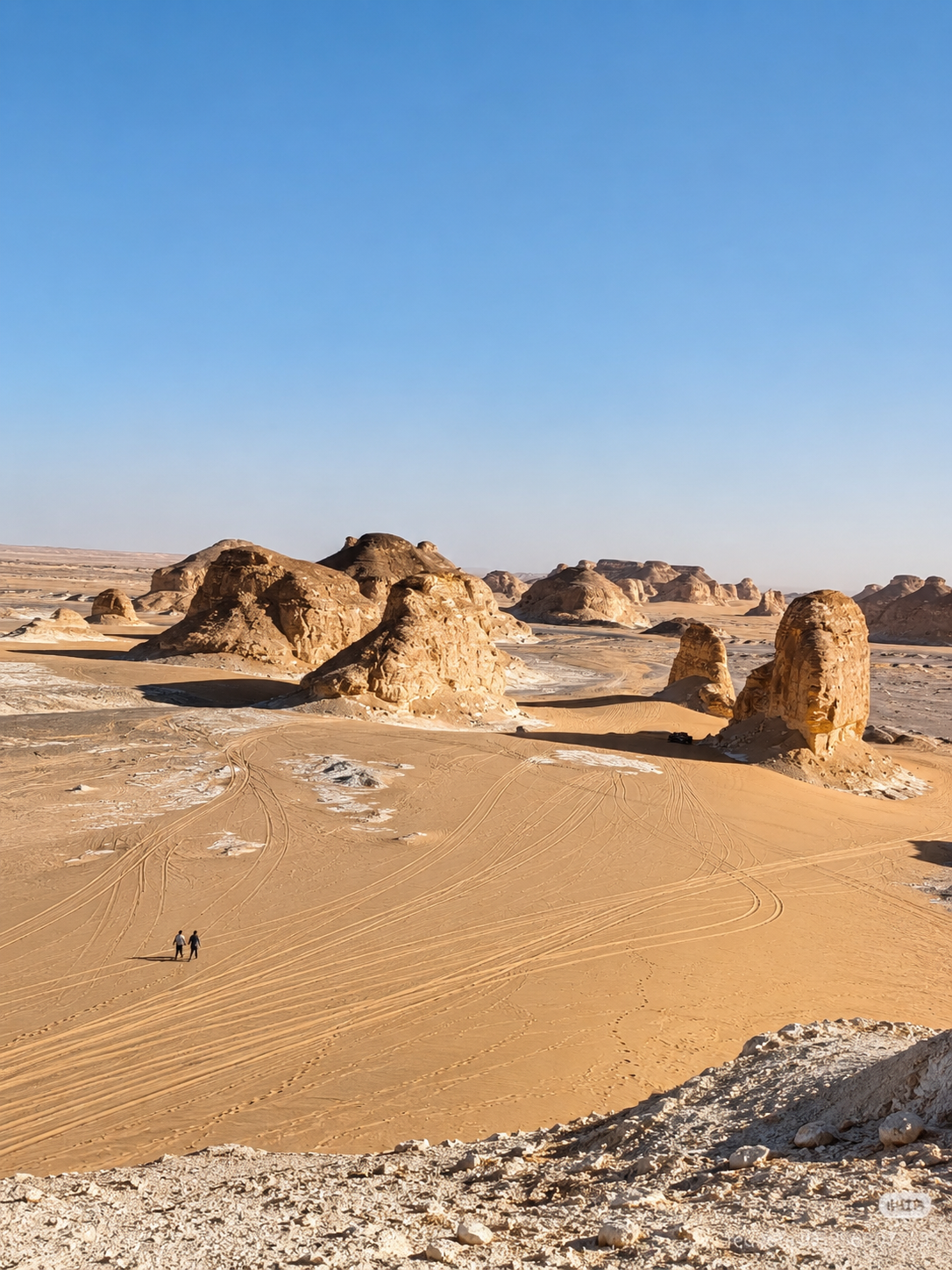
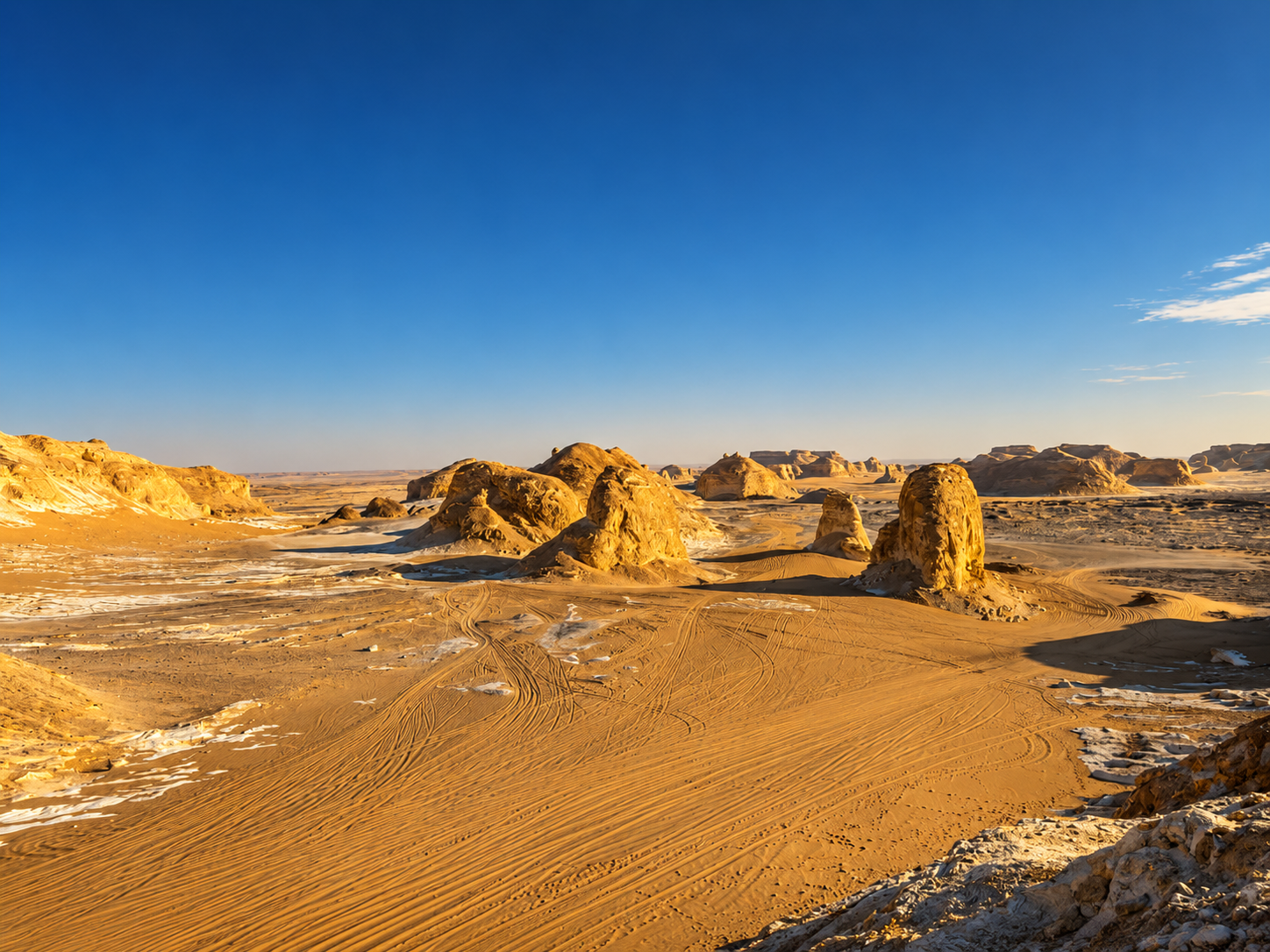
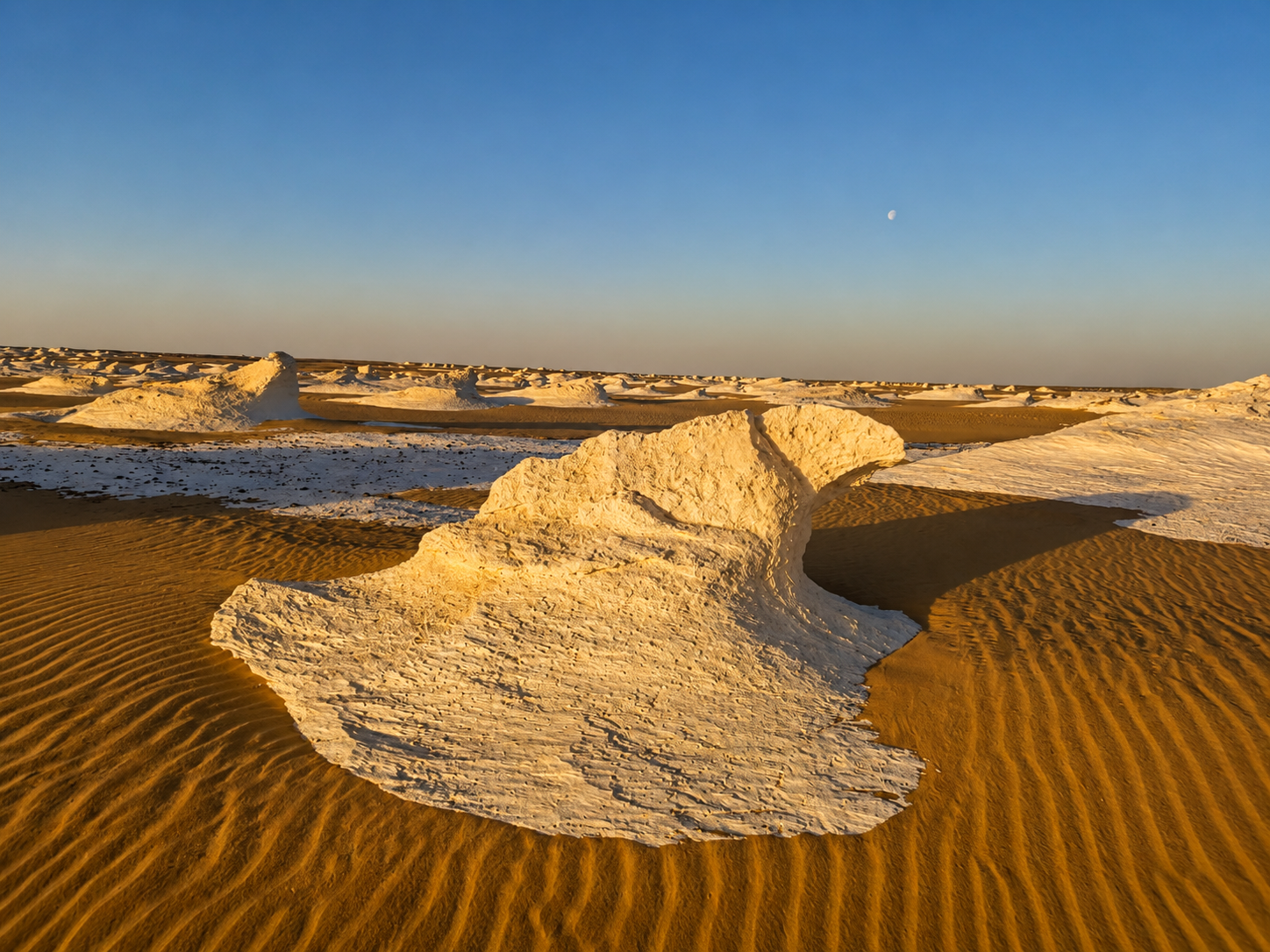
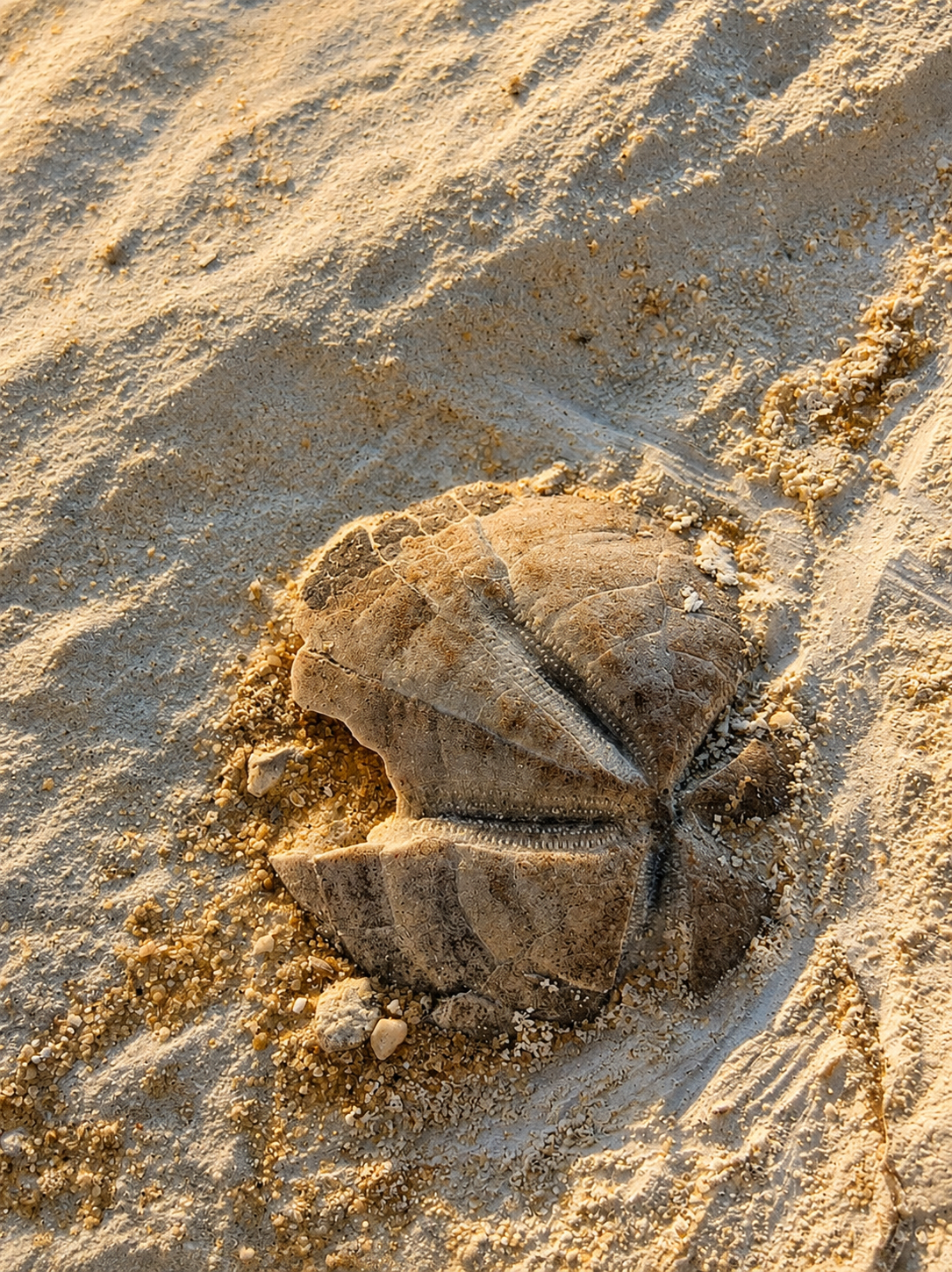
Crystal Mountain Egypt is one of the most distinctive geological stops on the classic safari route between Bahariya Oasis and the White Desert. Despite its name, it is not a mountain made entirely of crystal. Scientific research describes Gebel Crystal as an ancient karst and cave-related structure formed mainly from chalky limestone, with impressive calcite crystals exposed within the landscape.
Most travelers visit Crystal Mountain as part of a wider journey that follows:
Cairo → Bahariya Oasis → Black Desert → Crystal Mountain → Agabat Valley → White Desert → overnight camping.
This makes Crystal Mountain an important part of the complete White Desert Egypt experience rather than a destination that most international travelers visit on its own.
Egypt’s official tourism portal describes Crystal Mountain as a geological wonder of the White Desert region and explains that it was once associated with an underground cave system before becoming exposed at the surface. Visitors can now see its distinctive arch and sparkling mineral formations reflecting sunlight.
Scientific research provides an even more interesting explanation.
A 2025 study in the Journal of African Earth Sciences describes Crystal Mountain, also known as Gebel Crystal, as a famous karst feature in Egypt’s Western Desert. Researchers identify it as a large unroofed cave developed within chalky limestone of the Upper Cretaceous Khoman Formation, containing calcite crystals, sinkhole-related material, red sandstone and other cave-fill deposits.
So the real story of Crystal Mountain is much more fascinating than the tourist nickname suggests.
It is not simply a sparkling rock beside the road.
It is part of a geological landscape that preserves evidence of ancient caves, changing climates, groundwater, karst processes and millions of years of erosion.

Crystal Mountain is located in Egypt’s Western Desert on the wider route connecting Bahariya Oasis and Farafra Oasis.
Scientific research places Gebel Crystal along the road connecting the two oases and identifies it as part of the broader White Desert protected landscape.
For travelers coming from Cairo, the journey normally begins at Bahariya-Oase.
Bahariya is approximately 370 km southwest of Cairo and is the closest major Western Desert oasis to the capital.
From Bahariya, travelers change from a normal road vehicle to a suitable 4×4 and begin the desert safari.
The classic route can include:
Bahariya Oasis → Black Desert → Gabal El Marsos → El Hez → Crystal Mountain → Agabat Valley → White Desert.
You can see how all of these places connect in our White Desert Egypt Map & Route Guide.
Yes, but the answer needs some explanation.
Tour itineraries often use the phrase White Desert tour to describe the entire safari journey from Bahariya through the Black Desert, Crystal Mountain, Agabat and finally the famous white chalk formations.
Geologically, these are different landscapes.
However, modern research considers Gebel Crystal part of the wider White Desert Protected Area and its regional karst system.
Experience Egypt also presents Crystal Mountain as one of the major geological attractions of the wider White Desert and Farafra desert region.
For a traveler, the practical answer is simple:
Crystal Mountain is normally visited as part of the White Desert safari route.
You do not usually need a separate trip just for Crystal Mountain.
The name comes from the sparkling mineral crystals visible within parts of the formation.
When sunlight reaches exposed crystal surfaces, they can reflect light and create the sparkling appearance that gave the location its popular name.
However, calling it “Crystal Mountain” can create the wrong impression.
Some visitors imagine a mountain made entirely from giant transparent quartz crystals.
That is not what the geological evidence shows.
Scientific studies identify calcite crystals within the exposed cave-fill and karst structures of Gebel Crystal.
Calcite is a calcium carbonate mineral commonly associated with limestone and cave systems.
It can form beautiful crystalline structures when mineral-rich water deposits calcium carbonate inside cavities, fractures or caves.
That makes Crystal Mountain closely connected to the same carbonate geology that helped create the wider Formationen der Weißen Wüste.
The famous visible crystals are primarily described in scientific research as calcite, not as one enormous mountain of quartz.
This distinction is important.
Calcite and quartz can both form attractive crystals, but they have different chemistry and geological origins.
The host rock at Gebel Crystal is chalky limestone associated with the Khoman Formation, while calcite occurs within the cave-fill and karst structures.
So a more accurate description would be:
Crystal Mountain is a chalky-limestone karst feature containing striking calcite crystals.
That explanation is much closer to what geologists actually observe.
Ja.
This is one of the most interesting facts about the site.
Experience Egypt describes Crystal Mountain as a former underground cave that later became exposed at the Earth’s surface.
Scientific studies provide more detail.
Gebel Crystal is described as an unroofed cave.
An unroofed cave forms when erosion removes the rock that once covered an underground cave system.
Instead of entering the cave underground, you eventually see parts of the former cave structure exposed at the surface.
This helps explain the unusual appearance of Crystal Mountain.
The rocks you see today may represent remnants of a structure that once developed below the old ground surface.
Crystal Mountain did not form through one single process.
Its history involves several stages.
First, marine sediments accumulated and later became carbonate rocks, including chalky limestone.
The host rock at Gebel Crystal belongs to the Khoman Formation, which scientific research identifies as Upper Cretaceous in age.
Later, water moved through fractures and soluble carbonate rock.
Over long periods, this contributed to karst development and cave formation.
Mineral-rich water deposited calcite inside cavities and other spaces.
Additional sediments and materials entered parts of the cave system.
Then the landscape changed again.
Erosion removed overlying rock and gradually exposed parts of the old cave system.
Wind, weathering and desert erosion continued modifying the landscape after exposure.
What visitors see today is therefore the result of multiple geological chapters rather than a mountain suddenly appearing from the desert.


Karst is a type of landscape created largely when water interacts with soluble rocks such as limestone.
Water can move through fractures and gradually dissolve the rock.
Over time, this process can produce features such as:
caves, sinkholes, channels, cavities, natural openings and unusual limestone formations.
The White Desert contains numerous examples of karst landscapes.
Scientific research on White Desert National Park documents karst depressions, collapsed caves, natural openings, calcite deposits and other features across the Bahariya–Farafra region.
Crystal Mountain is one of the most visually accessible examples of this much larger geological story.
If geology is one of the main reasons you are interested in the White Desert, read our full White Desert Egypt Formations & Geology guide.
There is no useful single age for everything visible at Crystal Mountain.
Different parts of the geological story formed at different times.
The chalky limestone of the Khoman Formation hosting the site is Upper Cretaceous in age.
Later cave development, karstification, sediment filling, calcite growth, erosion and surface exposure occurred during subsequent geological periods.
That means the rock itself can be tens of millions of years old while some of the structures or deposits within it formed later.
This is a common geological misunderstanding.
The age of a rock and the age of the visible shape created from that rock are not necessarily the same.
Visitors should not expect a fantasy landscape covered in giant gemstones.
The attraction is more subtle.
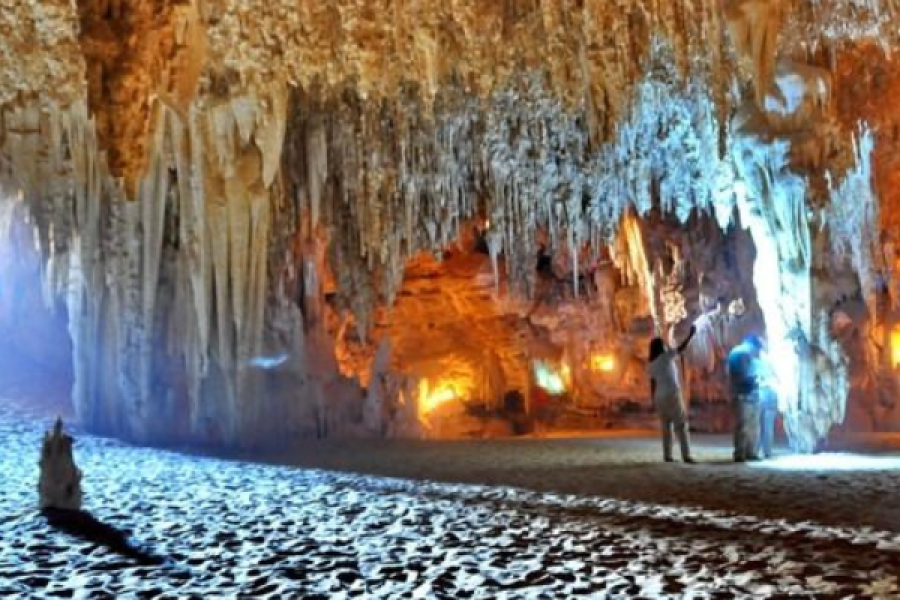
Crystal surfaces can appear inside cavities, along exposed structures and within parts of the formation.
Under strong sunlight, they can sparkle noticeably.
Research on White Desert karst describes calcite crystals ranging from very small forms to much larger visible crystals, with some cave-related calcite structures forming beds and crusts within the landscape.
For most travelers, the strongest visual feature is the combination of:
the rocky arch,
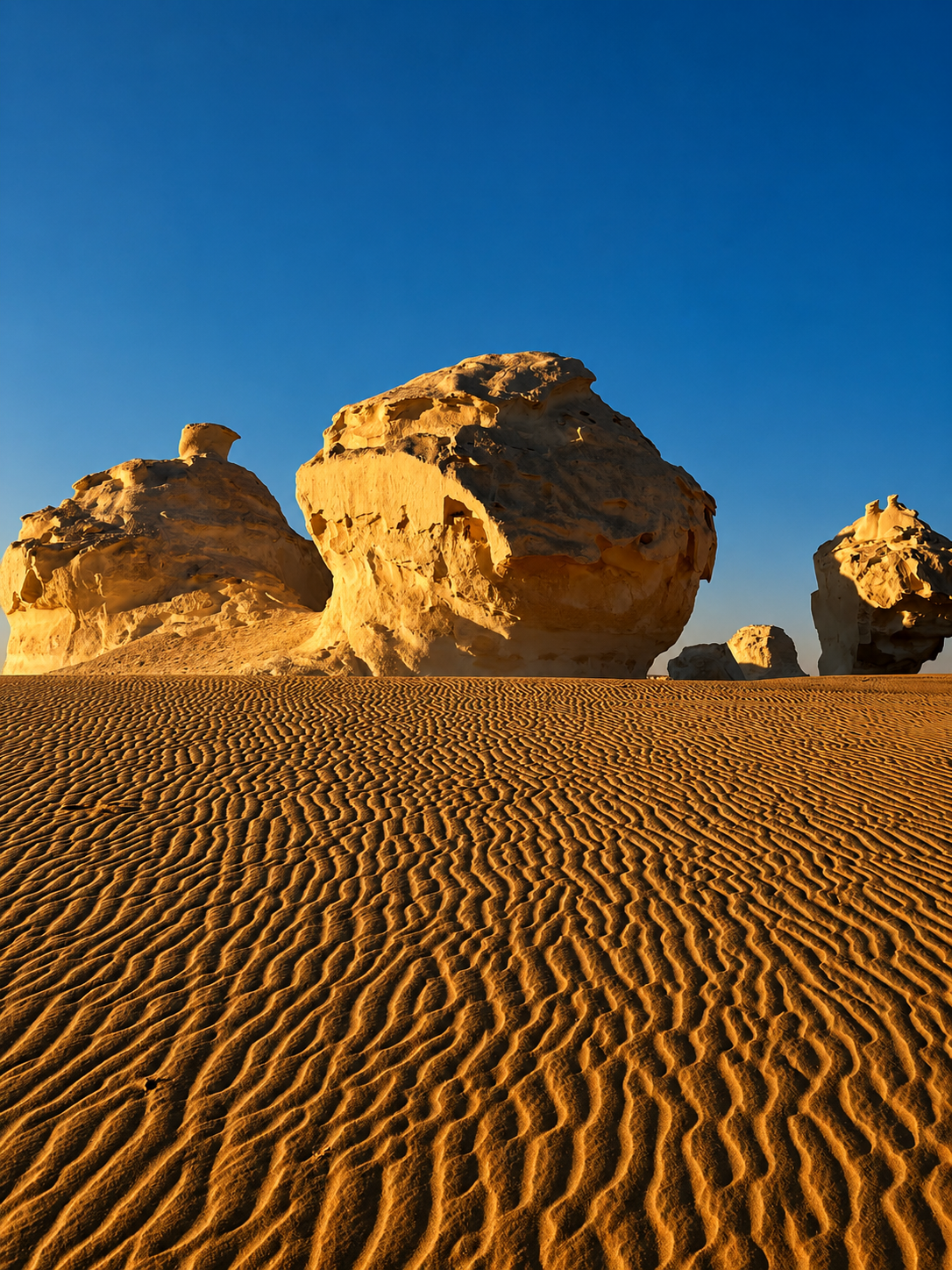
pale desert landscape,
crystal-bearing surfaces,
and surrounding Western Desert scenery.
You should not.
Crystal Mountain is part of a protected geological landscape.
The crystals are not souvenirs.
Every visitor who removes a piece gradually destroys the feature that future travelers came to see.
The responsible approach is simple:
photograph the crystals,
observe them,
leave them exactly where they are.
The same principle applies to fossils and geological material elsewhere in the Nationalpark Weiße Wüste.
It is better to explore carefully around the feature without treating it as a climbing attraction.
Karst formations may contain cavities, fractured rock and weakened surfaces.
Repeated climbing also increases physical damage to fragile geological features.
You do not need to stand on top of Crystal Mountain to appreciate it.
The most interesting aspects are visible from around the formation itself.
Follow your guide’s instructions and respect any current protected-area access rules.
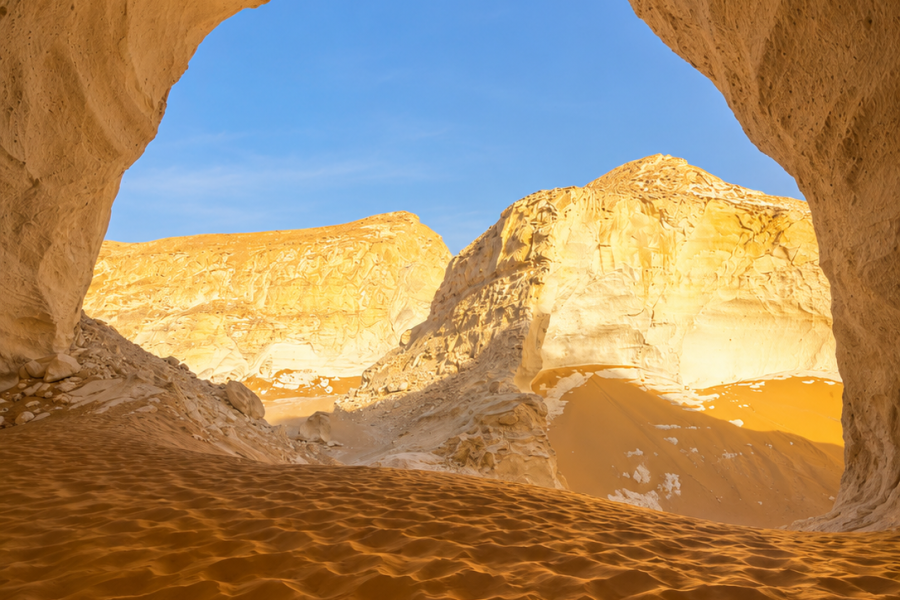
One of the most recognizable features at Crystal Mountain is its natural arch-like opening.
Experience Egypt specifically mentions the site’s iconic arch as one of the features visible when approaching Crystal Mountain.
The opening reflects the site’s history as an exposed karst and cave-related structure.
For photographers, the arch creates a strong natural frame against the desert sky.
It is one reason Crystal Mountain remains a memorable stop even though most travelers spend much less time there than they do in the White Desert itself.
For most standard White Desert tours, Crystal Mountain is a relatively short stop.
You generally do not need several hours.
The experience is usually about:
walking around the formation,
looking at the crystal-bearing surfaces,
photographing the arch,
understanding the geology,
then continuing toward Agabat.
A normal stop may feel brief compared with the time spent driving through the wider desert.
That is appropriate.
Crystal Mountain is one important chapter in a much larger route.
Yes, especially when it is part of a White Desert safari.
If you were traveling several hours only to see Crystal Mountain by itself, the answer might be different.
But that is not how most travelers experience it.
The normal journey includes multiple contrasting landscapes.
You can travel from:
to the Schwarze Wüste,
then Crystal Mountain,
Agabat,
and finally the White Desert.
Crystal Mountain becomes valuable because it adds another completely different geological feature to that sequence.
It makes the route richer.
Crystal Mountain is normally visited after exploring the Black Desert on the classic Cairo-to-White-Desert journey.
The two places look very different.
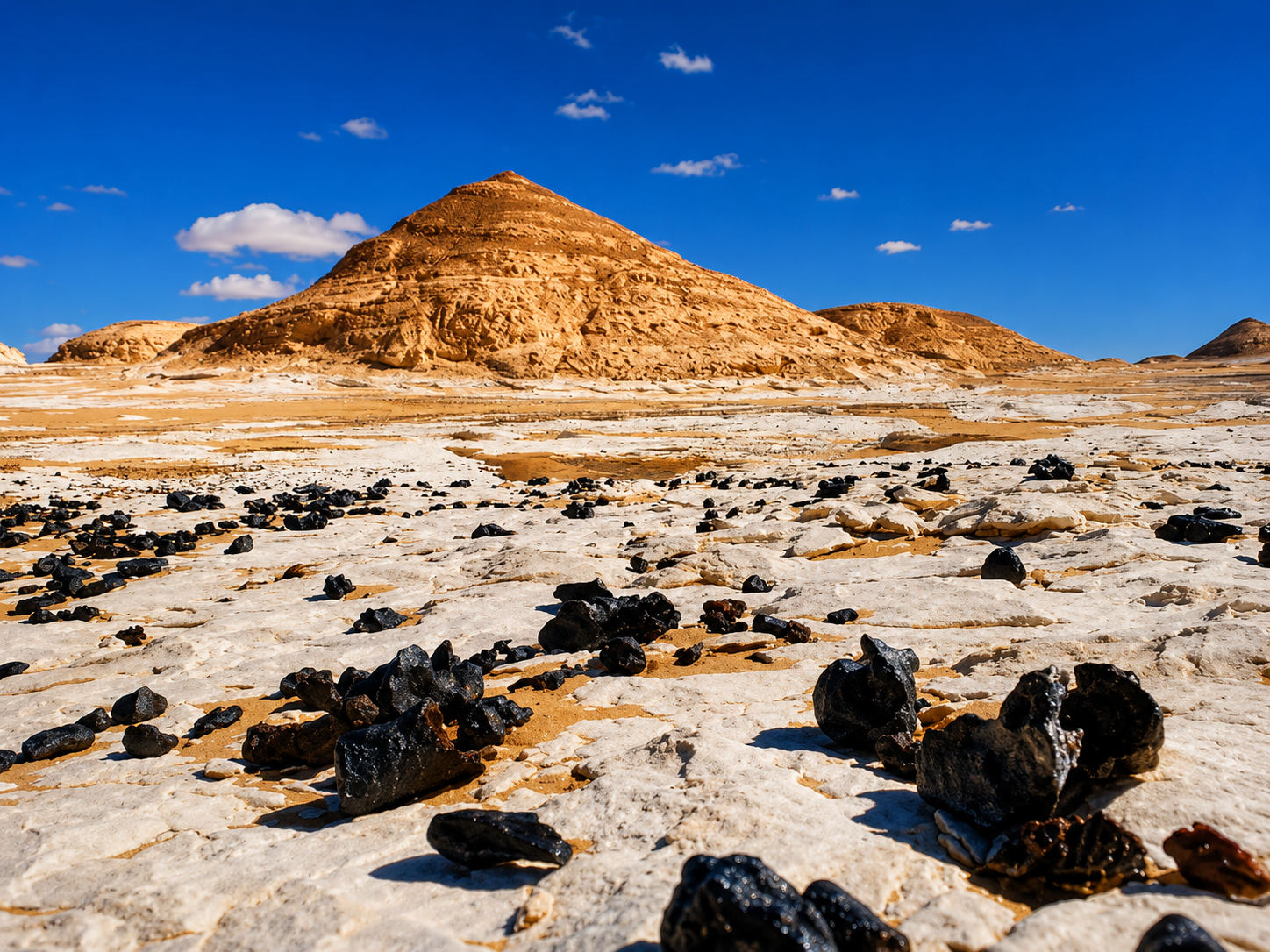
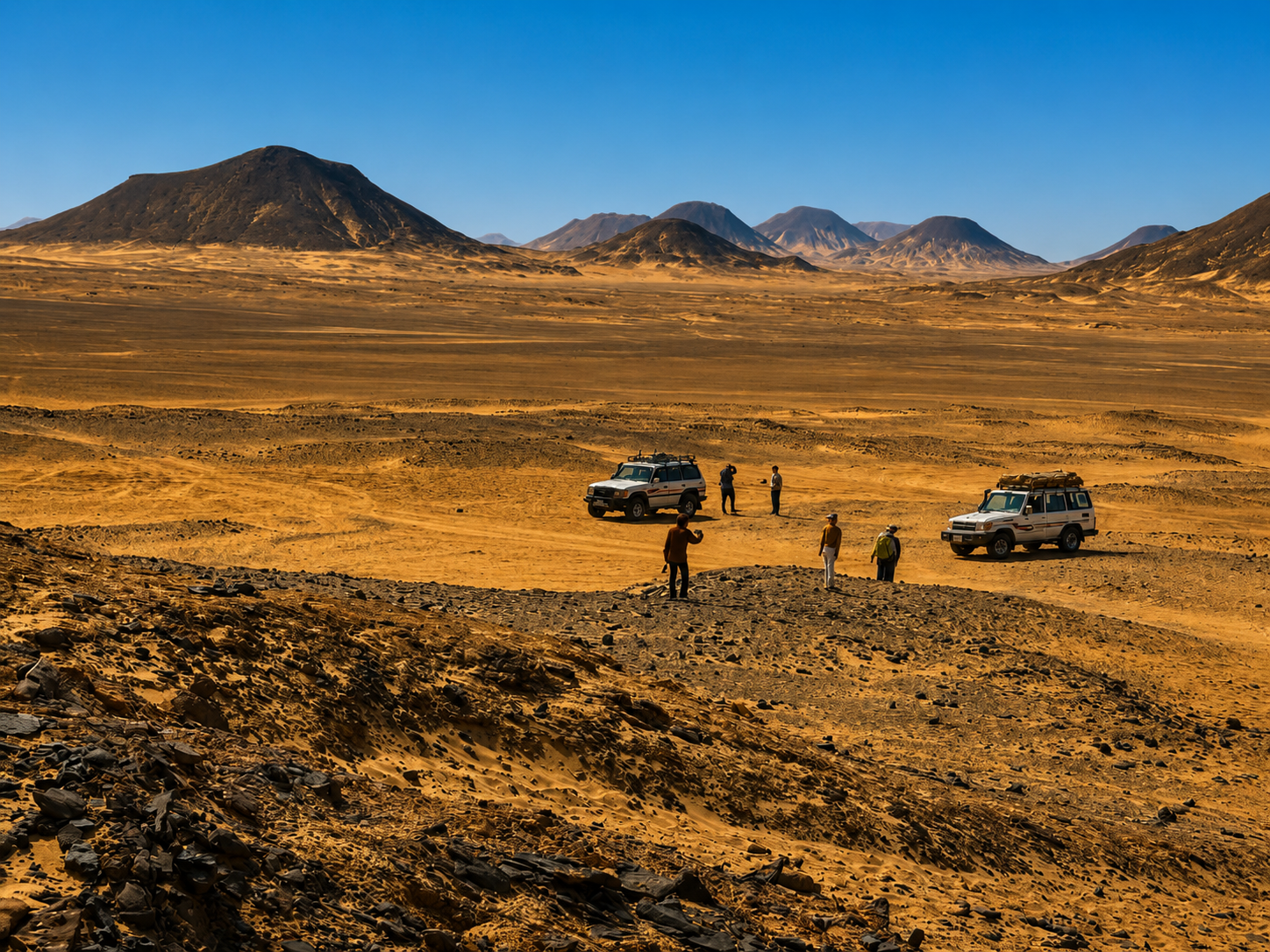
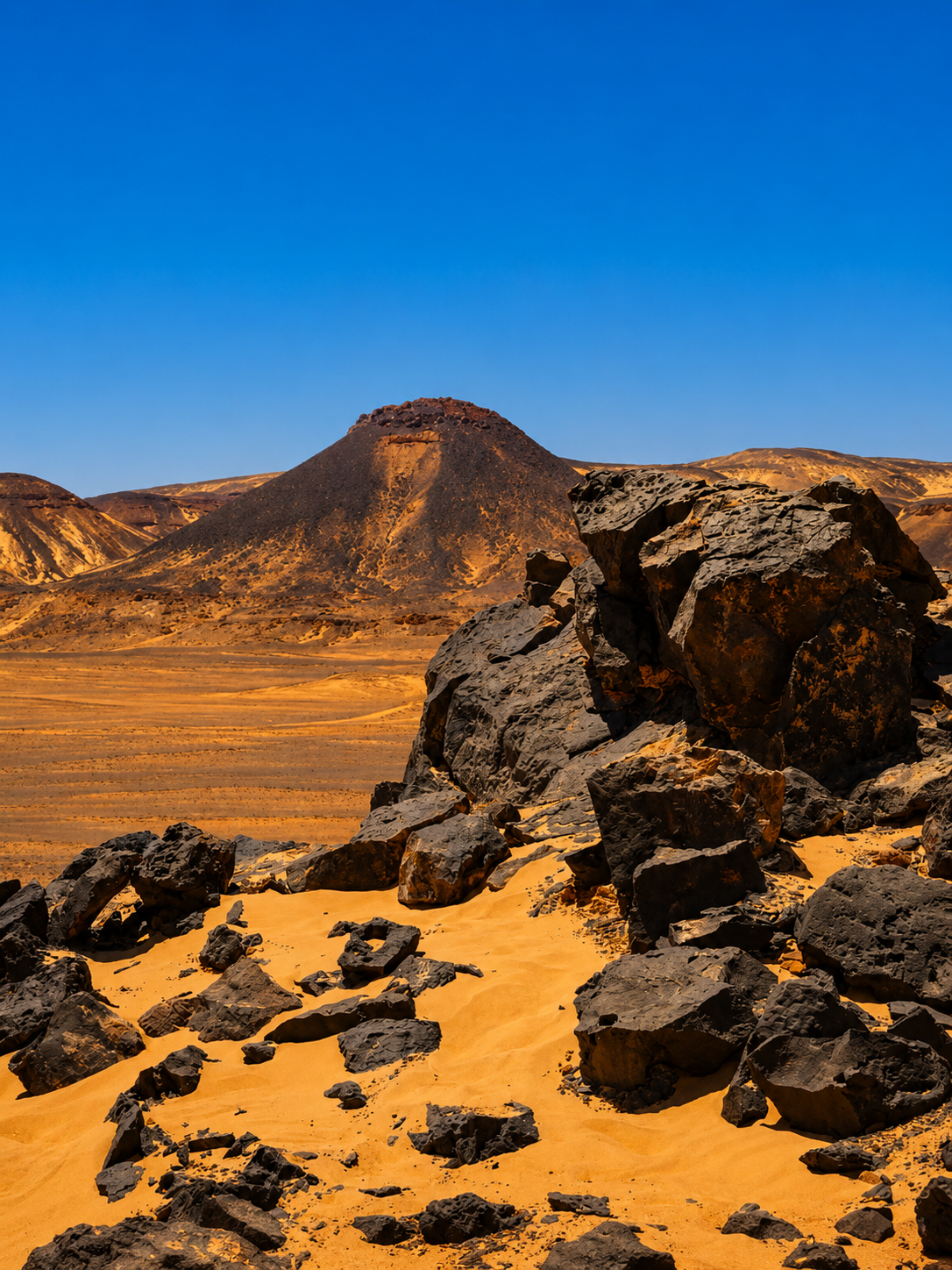
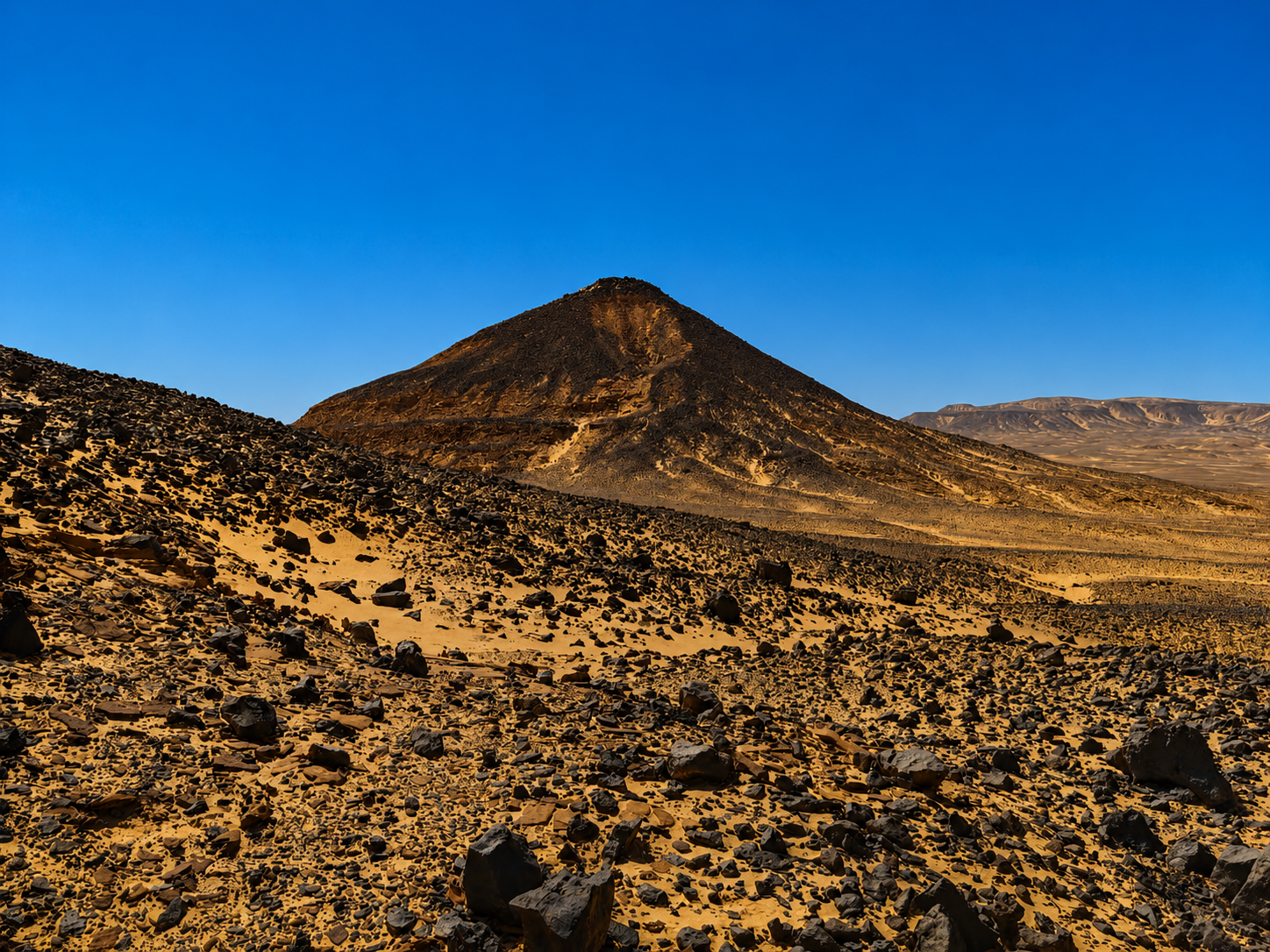
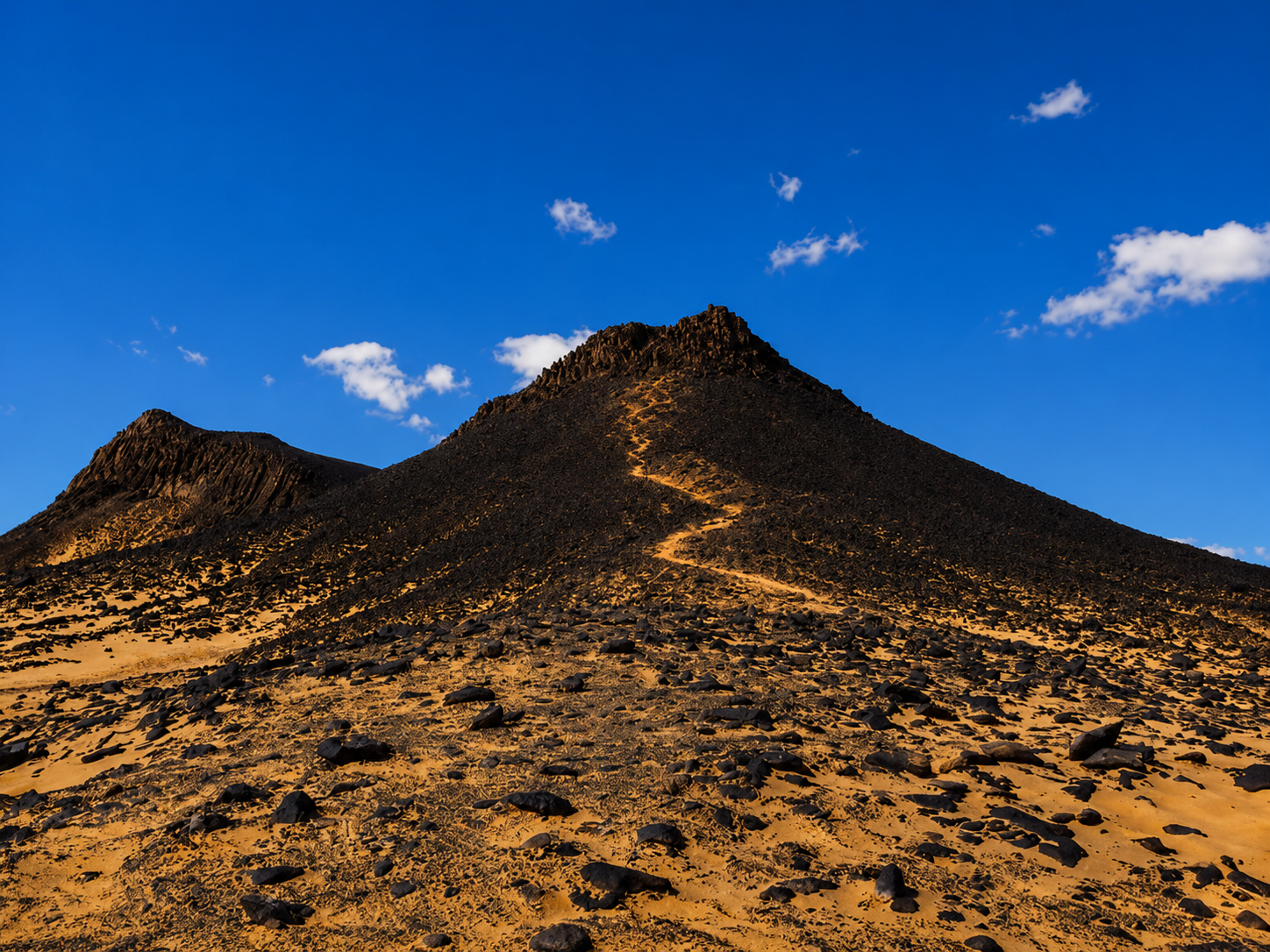
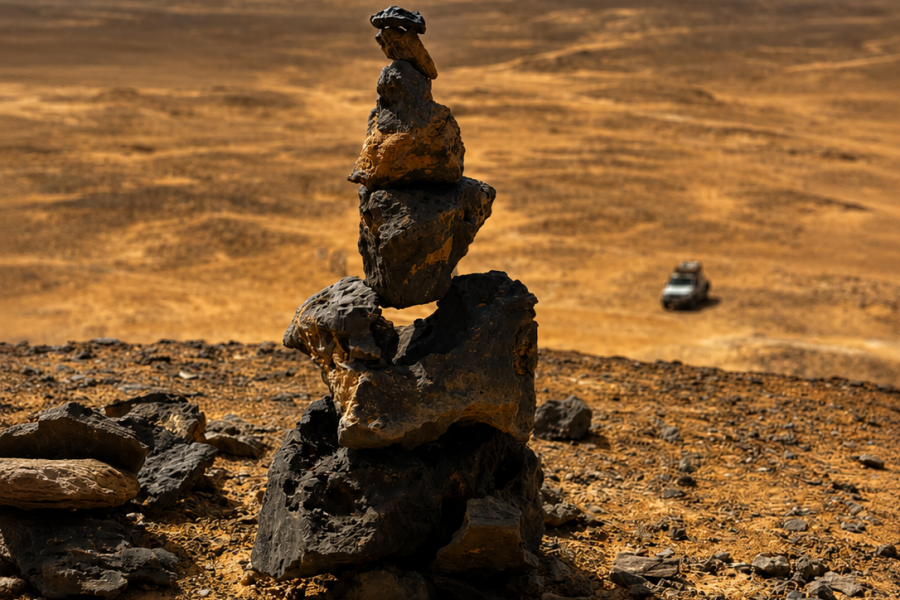
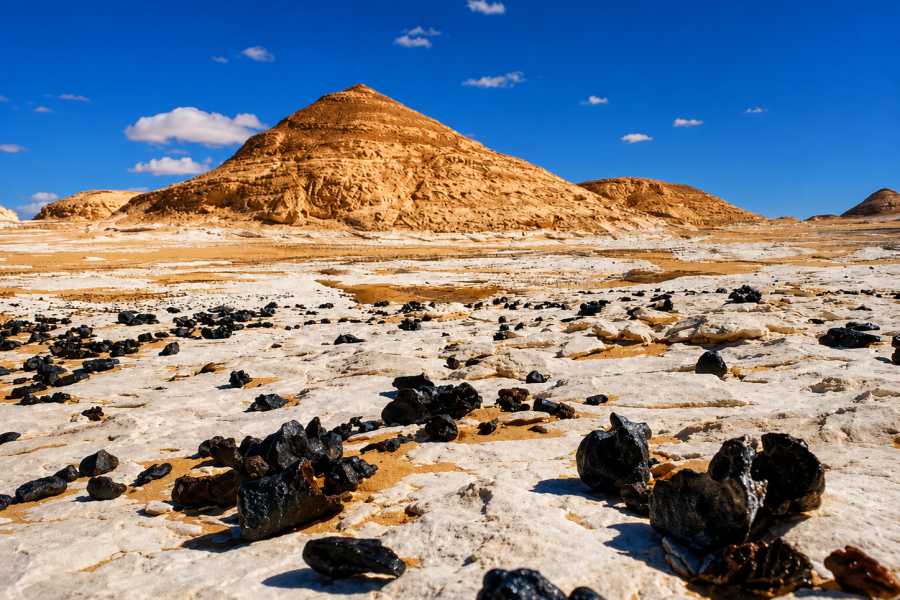
The Black Desert is defined visually by dark hills and dark stones.
Crystal Mountain draws attention toward pale carbonate rock and sparkling mineral formations.
Moving between them highlights how geologically varied Egypt’s Western Desert can be.
You do not need to decide between them.
Most good itineraries include both.
Our White Desert vs Black Desert Egypt guide explains how those two major landscapes fit together.
After Crystal Mountain, many White Desert routes continue toward Agabat.
The landscape changes again.
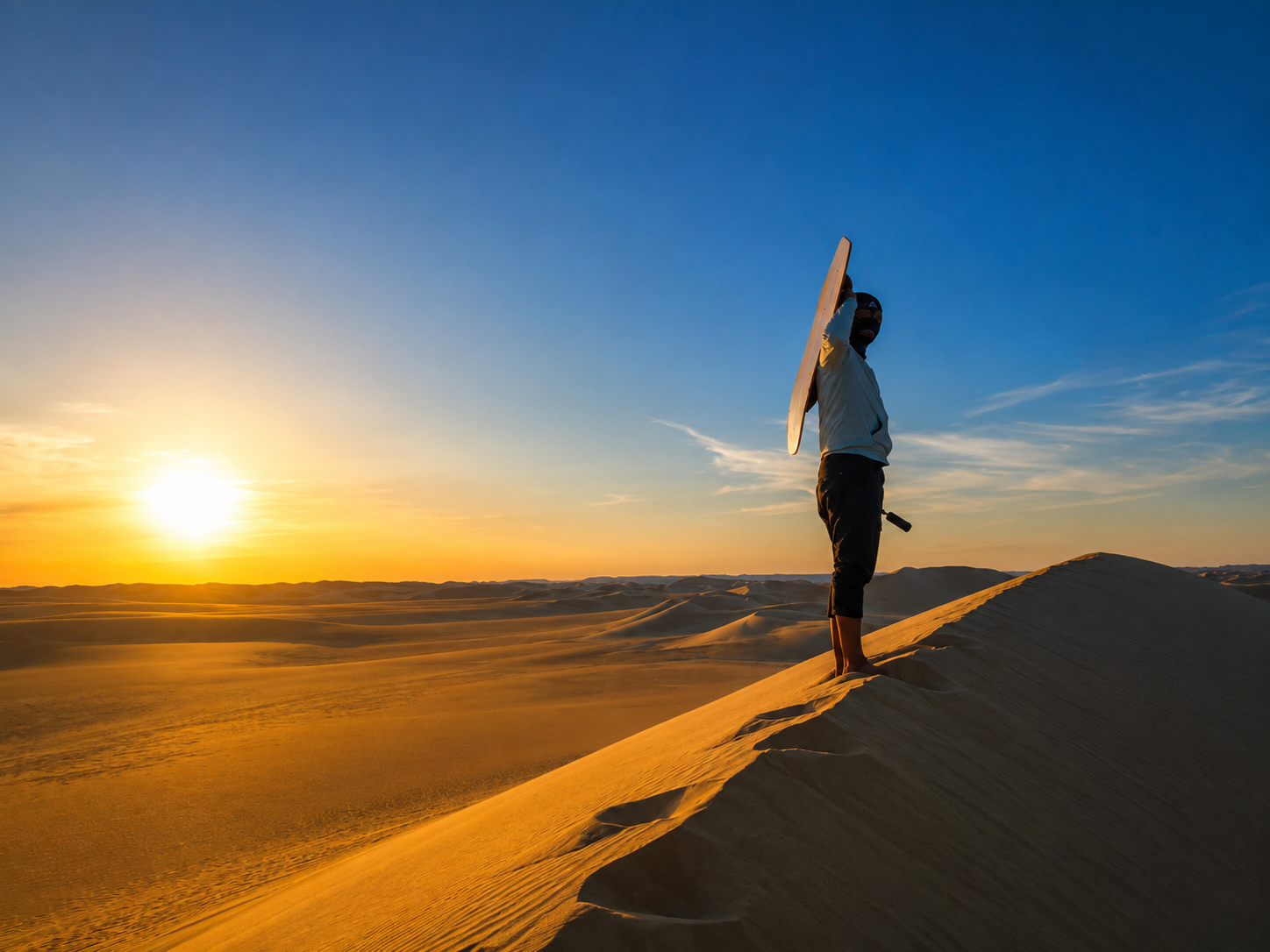
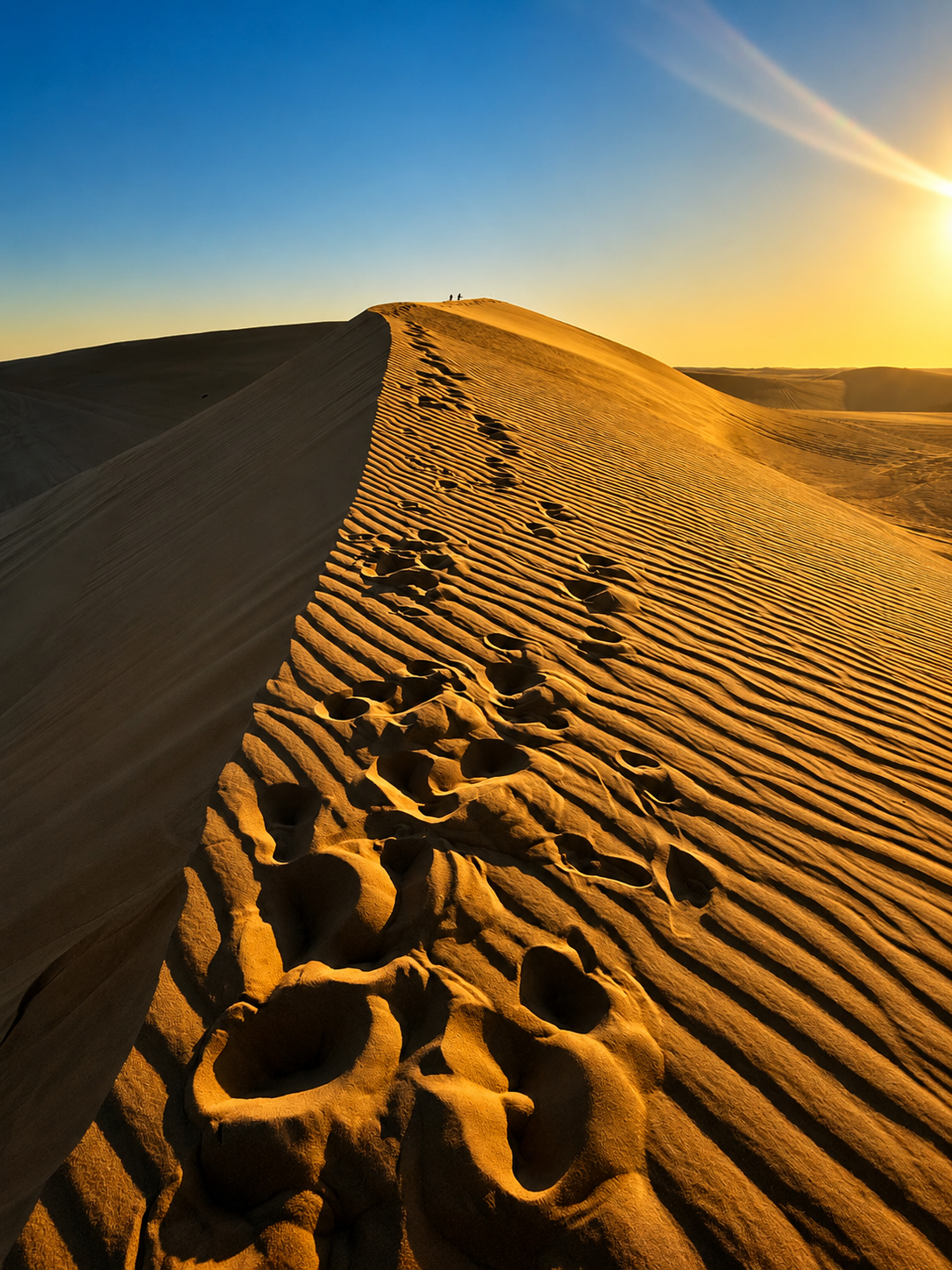
Agabat is famous for its golden sand, dunes and pale cliffs.
Experience Egypt describes it as one of the signature landscapes around Farafra and the White Desert region.
This creates a beautiful progression:
Black Desert → Crystal Mountain → Agabat → White Desert.
That sequence is one of the reasons the full safari is more interesting than simply driving directly toward the famous mushroom rocks.
Crystal Mountain belongs to the wider protected geological landscape associated with White Desert National Park.
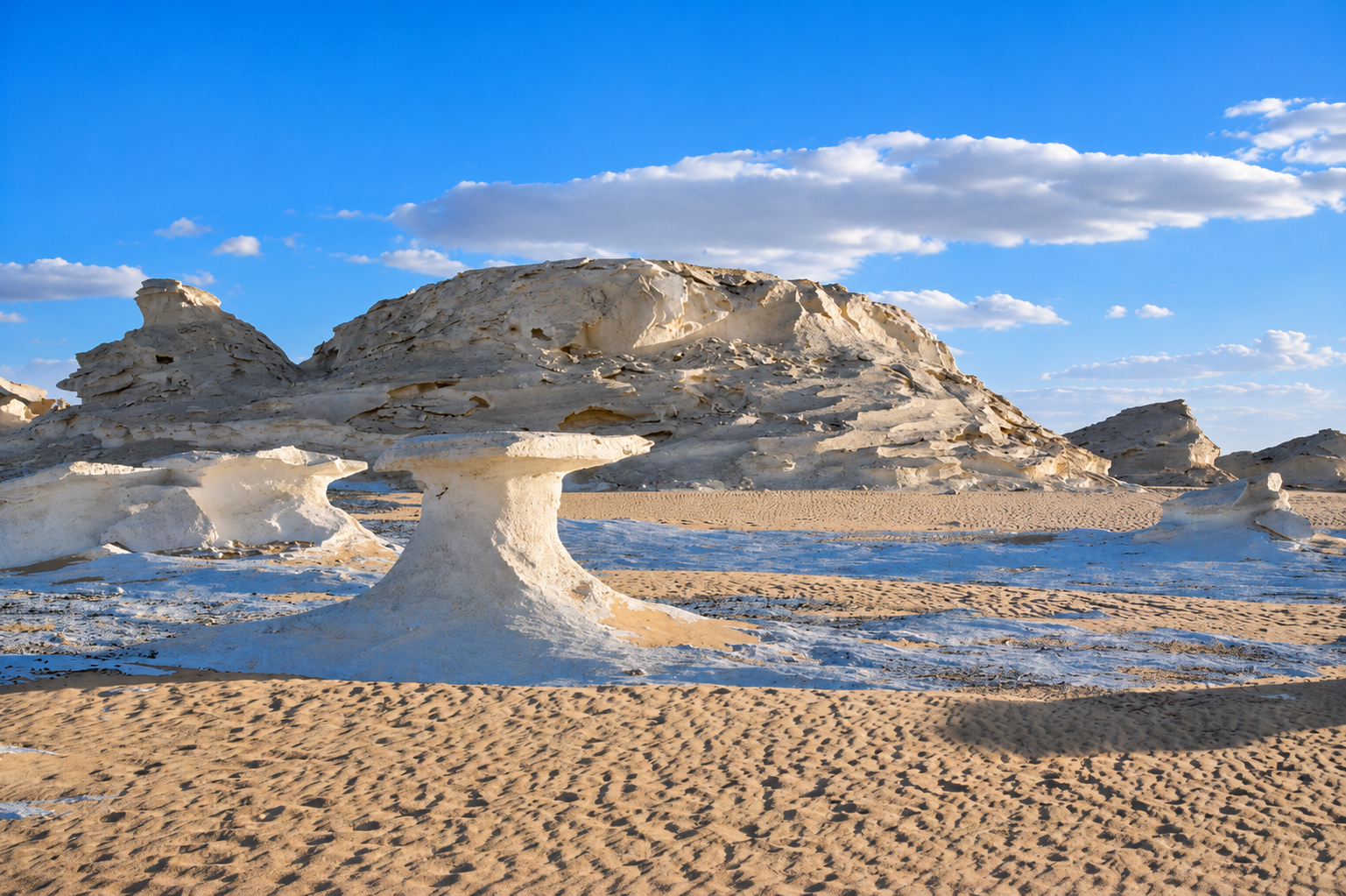
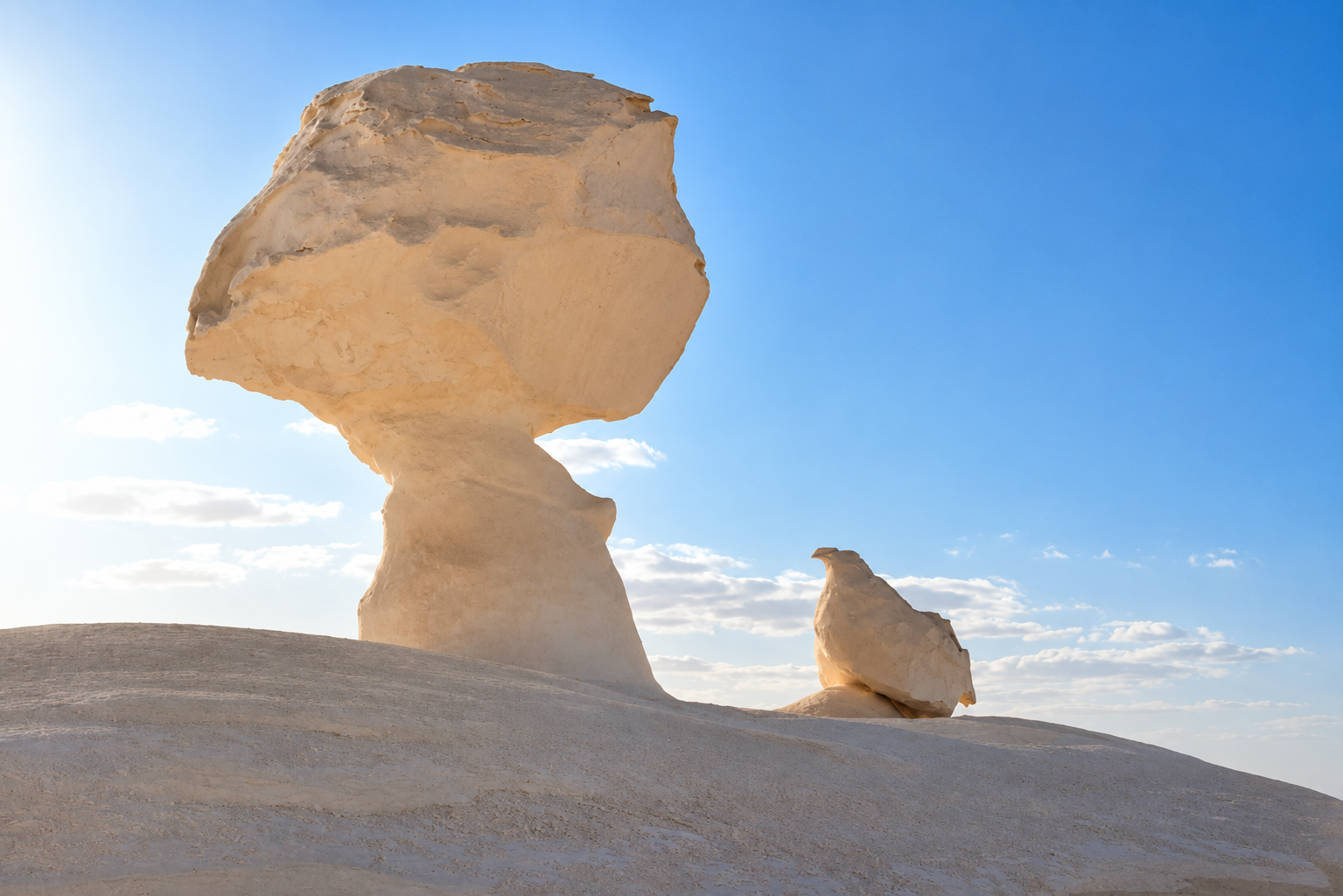
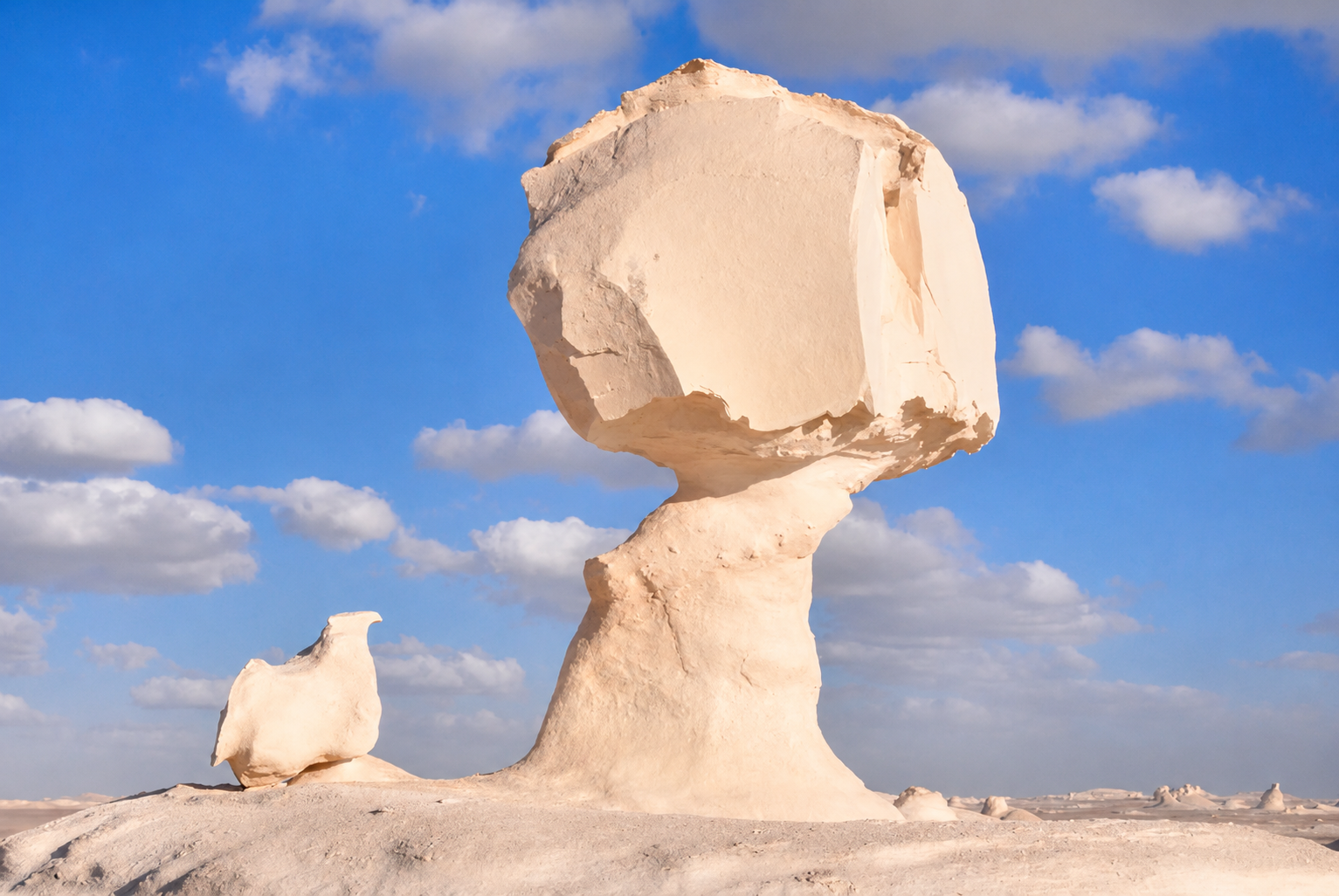
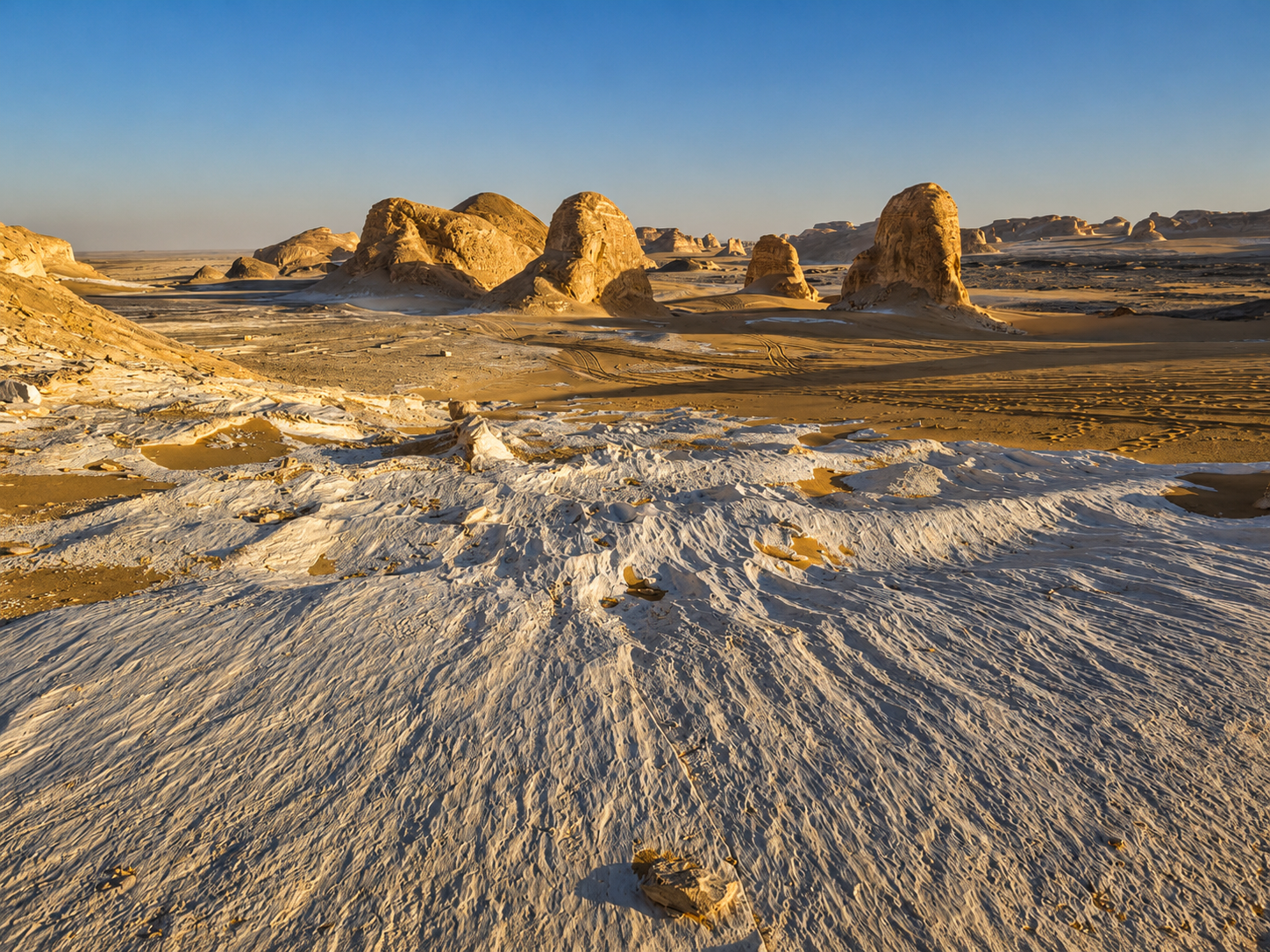
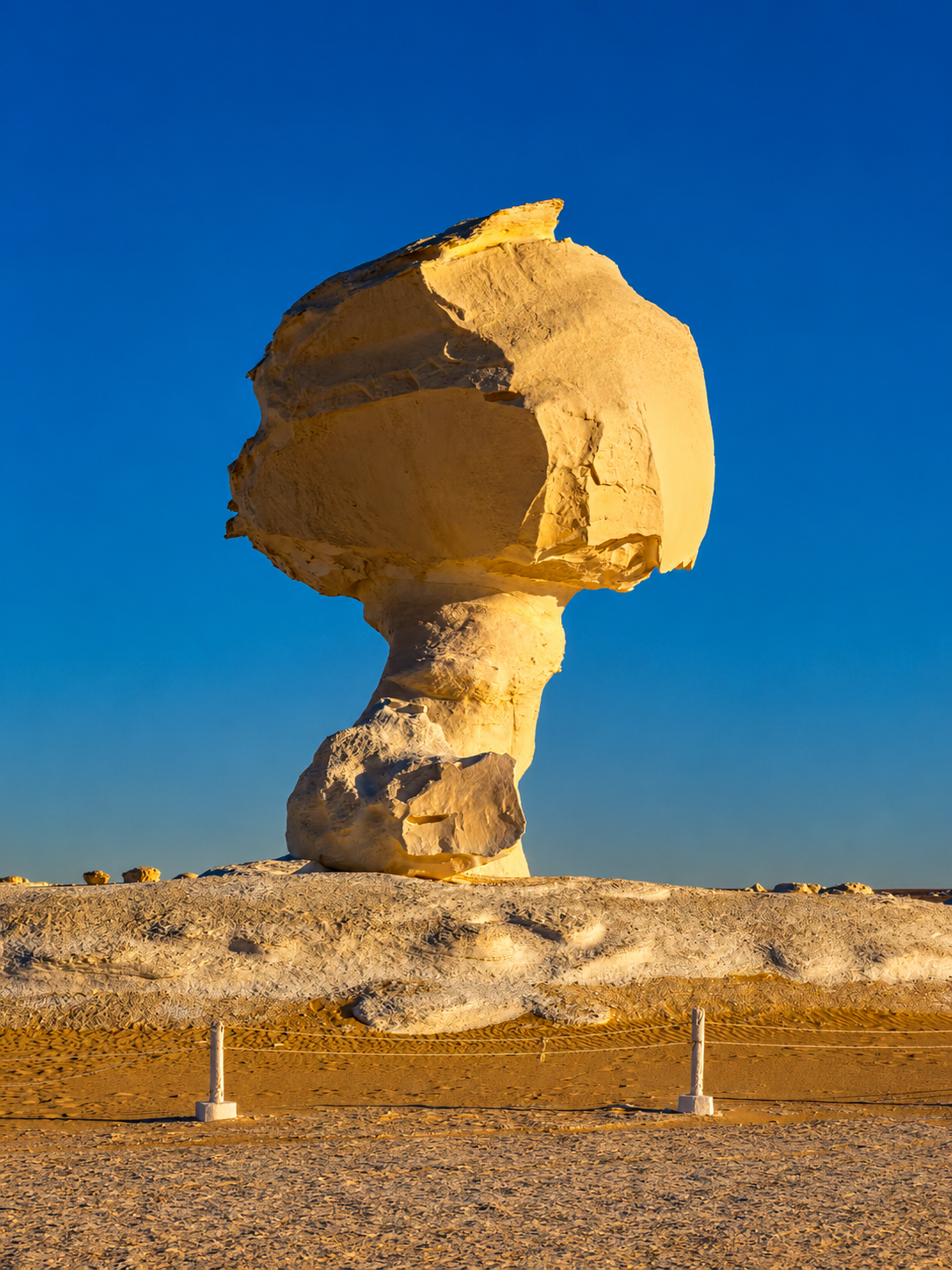
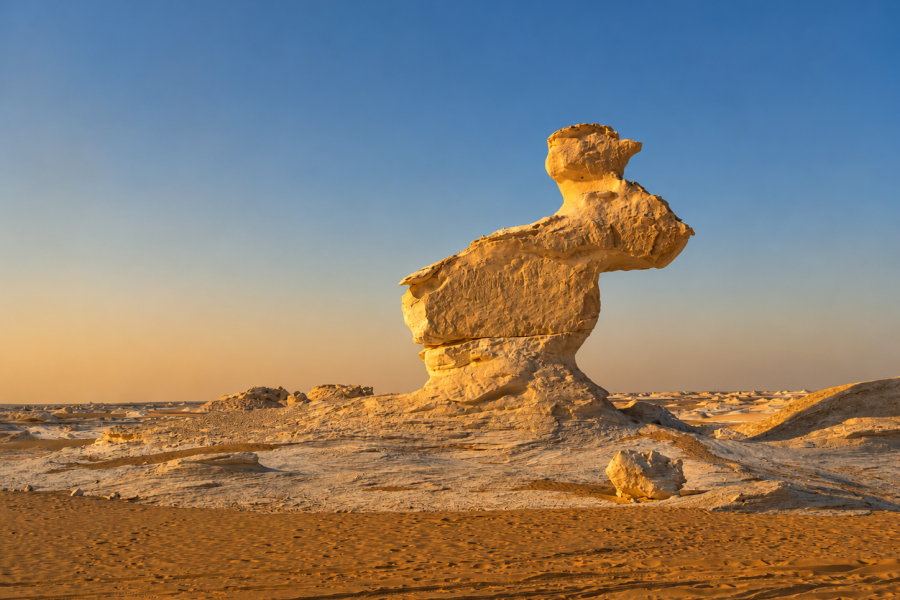
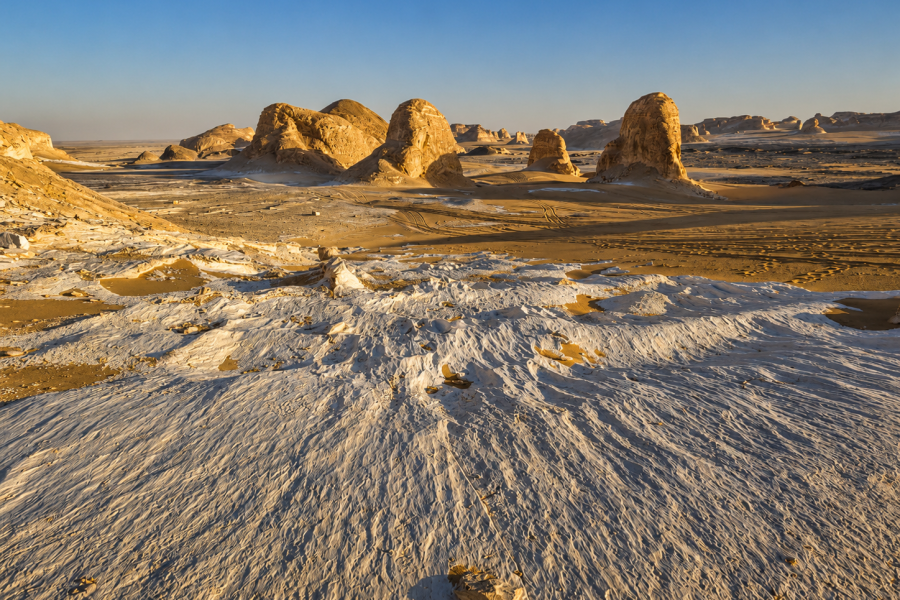
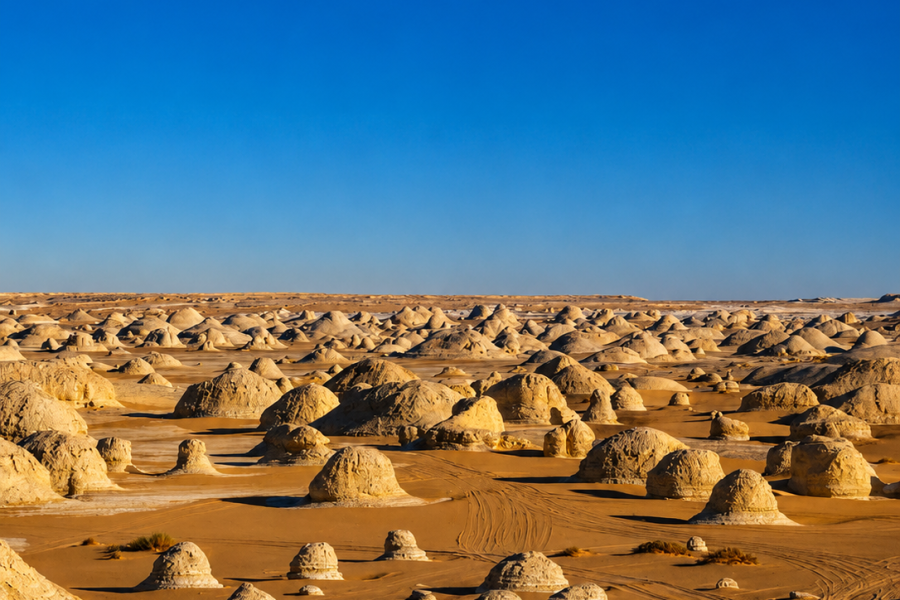
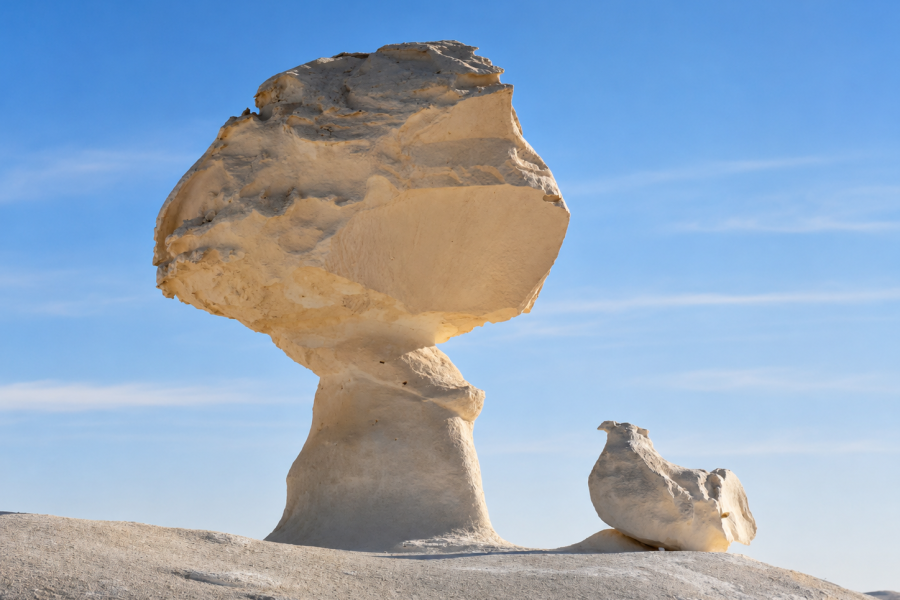
The White Desert itself is famous for chalk formations, mushroom-shaped rocks, marine fossils and unusual karst landscapes.
Experience Egypt describes the White Desert as an ancient seabed transformed into a natural gallery of chalk sculptures and fossil-bearing limestone.
Crystal Mountain adds evidence of underground geological processes to that story.
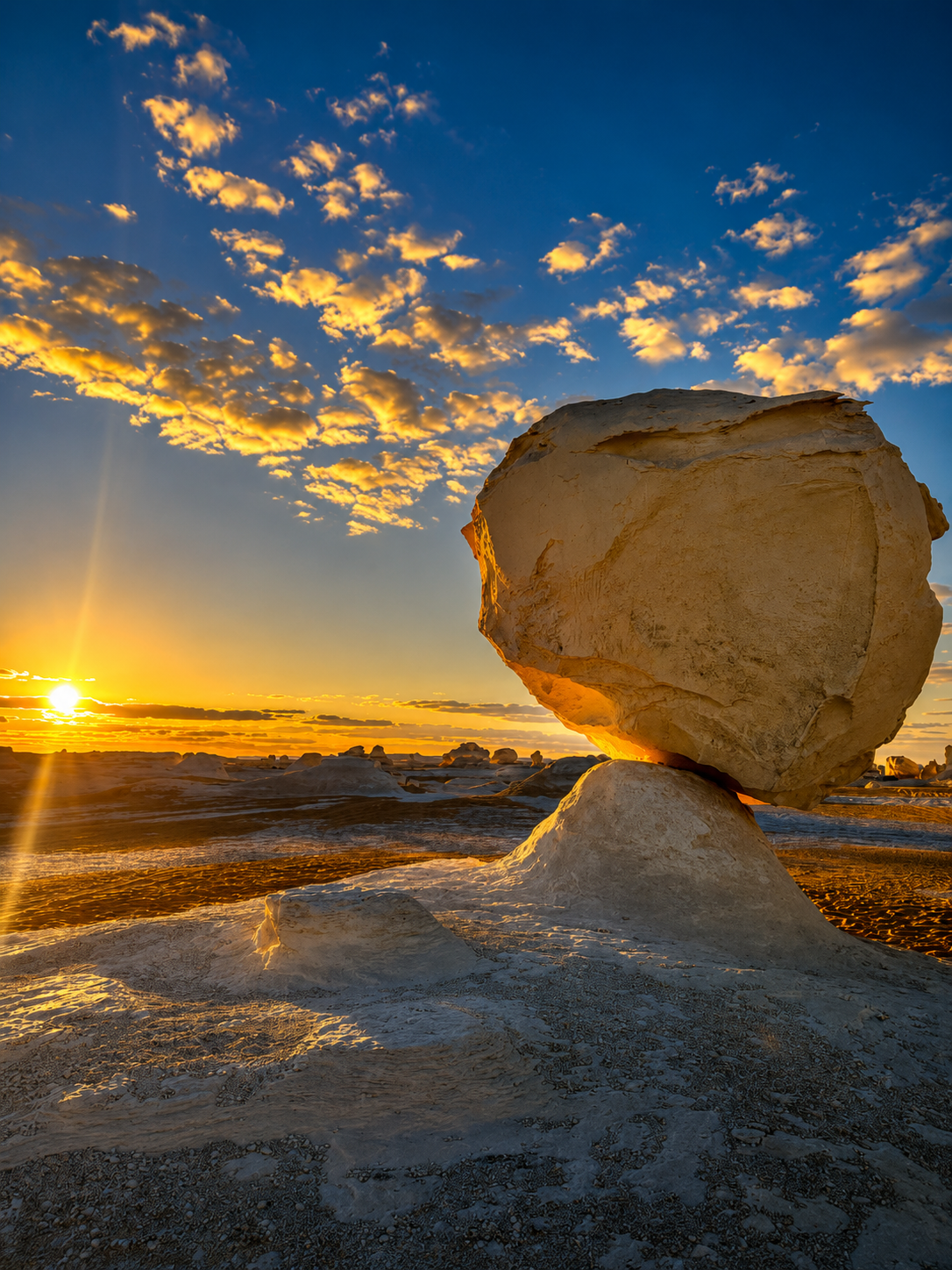
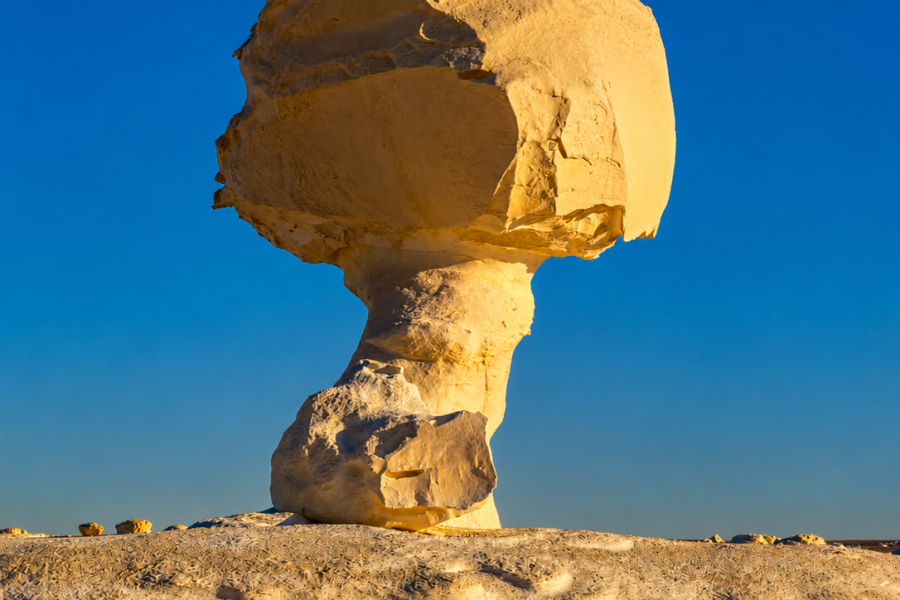
The famous white mushroom rocks show what erosion can sculpt above ground.
Crystal Mountain gives visitors a glimpse into old cave and karst processes.
Together, they help explain why this part of Egypt is much more than a sandy desert.
Most travelers should not plan Crystal Mountain as a standalone excursion from Cairo.
The practical route is:
Cairo → Bahariya Oasis → Black Desert → Crystal Mountain → Agabat → White Desert.
From Cairo, you first travel toward Bahariya Oasis.
Experience Egypt places Bahariya approximately 370 km southwest of Cairo, making it the closest Western Desert oasis to the capital.
After reaching Bahariya, the deeper safari continues using a suitable 4×4 vehicle.
Experience Egypt recommends experienced licensed guides and suitable 4×4 vehicles for desert excursions leaving Bahariya.
For the complete route from Cairo, use our White Desert Egypt Map & Route Guide und White Desert From Cairo.
Yes, as part of a long White Desert day tour.
The Eintägige Tour in die Weiße Wüste ab Kairo can combine the road journey to Bahariya with major desert stops including the Black Desert, Crystal Mountain, Agabat and the White Desert.
However, one day is demanding.
You spend a significant amount of time traveling.
If you have two available days, staying overnight gives you a much better overall Western Desert experience.
For most first-time travelers, the best itinerary is 2 days and 1 night.
A typical Day 1 can follow:
Cairo → Bahariya → Black Desert → Gabal El Marsos → El Hez → Crystal Mountain → Agabat → dunes → White Desert → sunset → camp.
Day 2 can include:
sunrise → breakfast → additional White Desert exploration → Bahariya → Cairo.
Our 2-tägige Weiße-Wüste-Tour ab Kairo (1 Übernachtung) follows this general structure.
The important advantage is that Crystal Mountain becomes part of a journey rather than the final destination.
By late afternoon, you continue toward the White Desert and finish the day at camp.
Three days are better if you want to explore the desert itself rather than simply visit the major named stops.
The current 2 Nächte, 3 Tage Camping-Tour durch die Weiße Wüste provides more time for off-road areas, dunes, valleys and camping.
Our current White Desert Egypt Itinerary includes Crystal Mountain on longer routes before continuing into deeper Western Desert landscapes.
This style of itinerary is especially suitable for:
Fotografen,
geology enthusiasts,
camping lovers,
and travelers who prefer slower exploration.
Travelers who want a balance between desert and oasis sightseeing can combine Crystal Mountain with a longer Bahariya program.
The current Tour zur Weißen Wüste und zur Oase Bahariya ab Kairo includes the Black Desert, Gabal El Marsos, El Hez, Crystal Mountain, Agabat and White Desert before adding a second stage focused on Bahariya attractions.
This is a strong option for travelers who want:
one night camping,
one hotel night,
Wüstensafari,
and more time in the oasis.
Ja.
The most interesting photographic elements include:
the arch,
crystal-bearing surfaces,
rock textures,
the open Western Desert background,
and the contrast between pale geology and deep blue sky.
Strong midday sunlight can actually help the crystals sparkle.
However, softer morning or afternoon light usually creates better texture in the surrounding rock.
If photography is one of the main reasons for your trip, do not focus exclusively on Crystal Mountain.
The route also offers excellent opportunities in the Black Desert, Agabat and White Desert.
Read our White Desert Egypt Photography Guide for the wider photography strategy.
Crystal Mountain can be visited whenever the wider Western Desert route is operating under appropriate conditions.
For most travelers, the most comfortable period is the cooler season.
Our Best Time to Visit White Desert Egypt guide recommends roughly October through April for most safari and camping trips, with October–November and March–April offering an especially comfortable balance for longer outdoor exploration.
Winter can also be excellent.
The main difference is that overnight campers need to prepare for colder desert nights.
You do not need specialist climbing gear for a normal sightseeing stop.
Comfortable closed shoes are preferable because the ground can be rocky and uneven.
Sun protection is also important.
Bring a hat, sunglasses and sunscreen.
If Crystal Mountain is part of an overnight safari, your packing requirements should be based on the complete White Desert trip rather than this one stop.
Use our White Desert Egypt Packing List before departure.
Yes, for most families already taking an organized White Desert safari.
Children often enjoy Crystal Mountain because the sparkling surfaces and unusual arch make the stop easy to understand visually.
Parents should still supervise children carefully.
Do not encourage them to:
break crystals,
remove rocks,
climb unstable structures,
or wander away from the guide.
The more important family consideration is normally the full journey from Cairo rather than Crystal Mountain itself.
Read our Egypt Desert Safari for Families & Kids for the wider trip-planning considerations.
Für viele Reisende, ja.
The normal visit does not require a long mountain climb.
However, the ground can be uneven.
Travelers with mobility concerns should tell the guide in advance so the vehicle can stop in a practical location and the walking portion can be adapted.
Remember that the more demanding part of the overall experience is often:
the long Cairo road journey,
4×4 travel,
and camping,
rather than the Crystal Mountain stop itself.
Crystal Mountain is usually visited as part of an organized Western Desert safari.
The location itself should be approached as a fragile geological site.
Visitors should avoid climbing unstable sections, breaking formations or entering areas their guide considers unsafe.
For wider desert travel, Experience Egypt recommends working with experienced licensed guides who know the terrain and using suitable 4×4 vehicles outside Bahariya.
The broader White Desert region is remote, so the correct vehicle, route knowledge, water, permits and logistics matter.
For the wider Western Desert safari, professional local guidance is strongly recommended.
Crystal Mountain is not simply a roadside attraction within a normal city destination.
It is part of a remote desert region.
Experience Egypt advises travelers to check current permits and regulations with an authorized tour guide or travel agency before desert excursions around Farafra and the White Desert.
An experienced guide also gives the stop more meaning.
Without context, you see sparkling rock.
With geological explanation, you understand that you are looking at the exposed remains of an ancient cave and karst system.
Crystal Mountain is especially vulnerable because its most attractive feature is exactly what visitors may be tempted to touch or collect.
A small crystal may seem unimportant.
But if thousands of visitors each take one piece, the geological feature gradually disappears.
The correct behavior is simple:
look,
photograph,
learn,
leave everything in place.
Do not carve names into the rock.
Do not deliberately break crystal surfaces.
Do not remove calcite.
Do not leave rubbish behind.
Do not climb fragile sections for social-media photographs.
The value of Crystal Mountain comes from the fact that these geological features have survived for enormous periods of time.
Tourism should not become the process that destroys them.
The White Desert is the stronger destination overall.
Crystal Mountain is the stronger geological stop.
You would not normally travel from Cairo and choose Crystal Mountain instead of the White Desert.
The two are complementary.
Crystal Mountain adds another layer to the journey.
The White Desert provides the larger landscape, iconic formations, camping, sunset and sunrise.
If you only have limited time, visit both on the same route.
These two stops offer very different experiences.
The Schwarze Wüste is primarily about broad dark landscapes and hills.
Crystal Mountain is about a concentrated geological feature containing exposed calcite and cave-related structures.
The Black Desert works at landscape scale.
Crystal Mountain works at detail scale.
Together they provide much more variety than either would alone.
Crystal Mountain is primarily geological and concentrated.
Agabat is scenic and expansive.
At Crystal Mountain, you are likely to walk around one recognizable feature.
At Agabat, you look across large areas of golden sand, dunes and white cliffs.
For photographers:
Agabat often provides the stronger large-scale landscape.
For geology enthusiasts:
Crystal Mountain may be more fascinating.
Again, the best safari includes both.
There is normally no reason to think of Crystal Mountain as a separate standalone trip price.
It is usually included as one stop inside a wider White Desert safari.
The total trip cost therefore depends on:
the number of days,
Anzahl der Reisenden,
private or shared arrangements,
Camping,
transportation,
and the complete safari route.
Use our White Desert Egypt Cost Guide for the current White Desert pricing structure.
The key question should not be:
“How much does Crystal Mountain cost?”
It should be:
“Which White Desert itinerary includes Crystal Mountain and gives me the best overall route?”
For most first-time visitors, the answer is the classic 2-day/1-night trip.
For someone visiting the region for the first time, I would choose:
Tag 1
Cairo → Bahariya Oasis → Black Desert → Gabal El Marsos → El Hez → Crystal Mountain → Agabat → dunes → White Desert → sunset → overnight camp.
Tag 2
Sunrise → breakfast → White Desert exploration → Bahariya → Cairo.
This route gives Crystal Mountain exactly the right role.
It is an interesting geological highlight without consuming the entire day.
The journey keeps building until you reach the White Desert in the afternoon.
The recommended tour is the 2-tägige Weiße-Wüste-Tour ab Kairo (1 Übernachtung).
Travelers wanting deeper exploration should choose the 2 Nächte, 3 Tage Camping-Tour durch die Weiße Wüste.
Yes, especially when you visit it as part of a White Desert safari.
Crystal Mountain is not the biggest attraction in Egypt’s Western Desert.
It does not need to be.
Its value comes from the geological story it adds to the route.
You travel from the green environment of Bahariya.
The landscape becomes dark in the Black Desert.
Then you reach an exposed ancient karst feature containing sparkling calcite.
Afterward, you continue into the enormous scenery of Agabat and eventually the surreal chalk formations of the White Desert.
Crystal Mountain helps connect those landscapes.
And once you understand that it represents the exposed remains of an ancient cave system rather than a fantasy mountain made from gemstones, it becomes even more interesting.
It is a place where the name attracts you first.
But the geology is what makes it memorable.