

White Desert Egypt is a protected chalk landscape in Egypt’s Western Desert, famous for brilliant white rock formations, mushroom-shaped hills, desert camping, 4×4 safaris and some of the country’s most unusual geological scenery. Most travelers visit from Cairo through Bahariya Oasis, and for a first trip, 2 days and 1 night is usually the best balance between travel time and experience.
A classic journey follows:
Cairo → Bahariya Oasis → Black Desert → Crystal Mountain → Agabat → White Desert → overnight camping → sunrise → Cairo.
The White Desert is officially a protected landscape. Egypt’s Environmental Affairs Agency says the protectorate was declared in 2002, covers approximately 3,133.5 km², and is important for its karst landscape, white chalk, fossils, wildlife and prehistoric archaeological evidence.
For many visitors, the experience becomes one of the biggest contrasts in an Egypt itinerary.
One day you may be walking beside the Pyramids of Giza or exploring Cairo.
The next, you can be surrounded by white chalk formations, dark desert hills, dunes and an open night sky hundreds of kilometers from the capital.
This guide covers everything you need to plan the trip: where the White Desert is, how to reach it, what to see, how many days you need, camping, costs, the best season, safety, packing and the best White Desert tours.
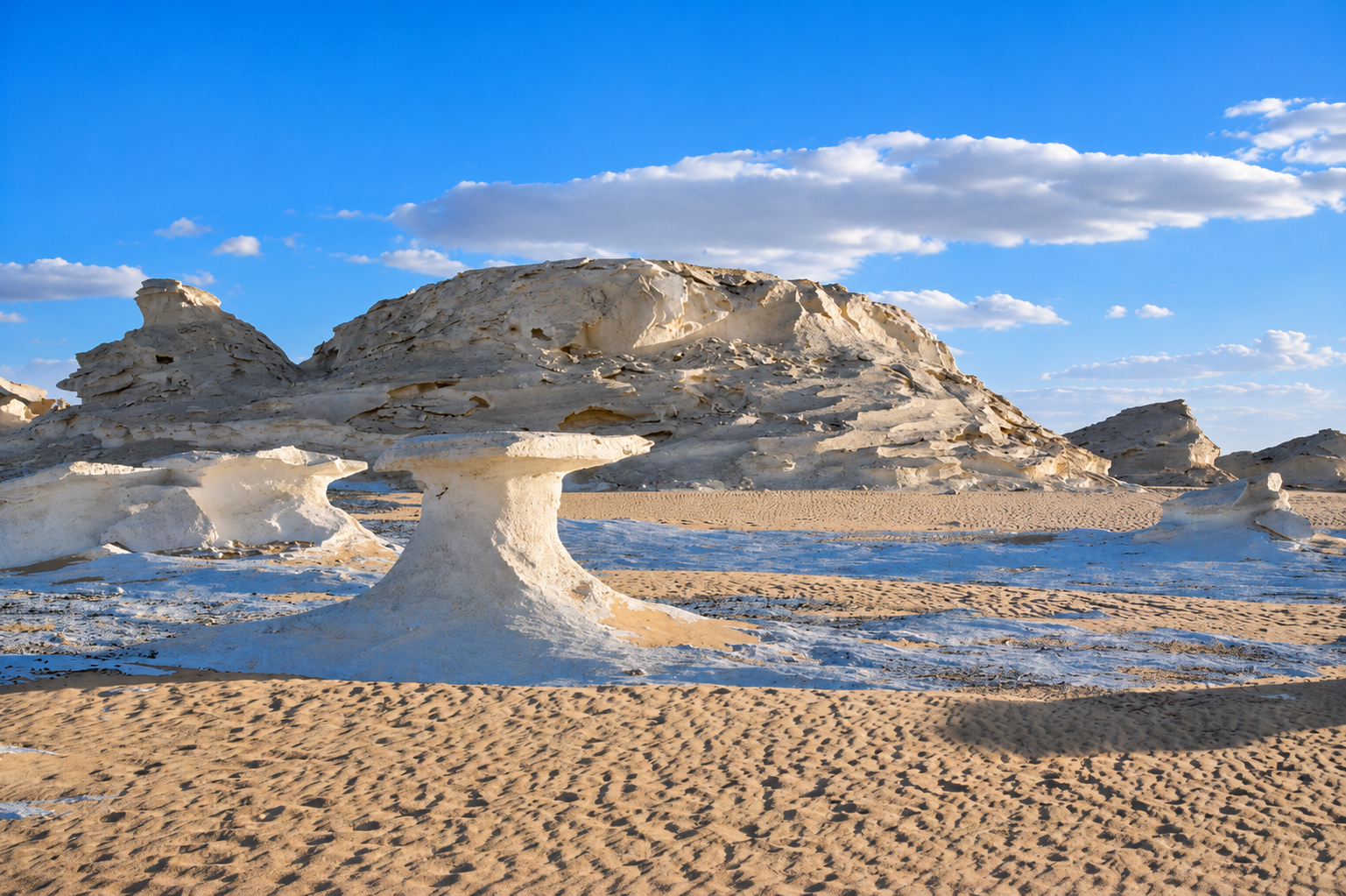
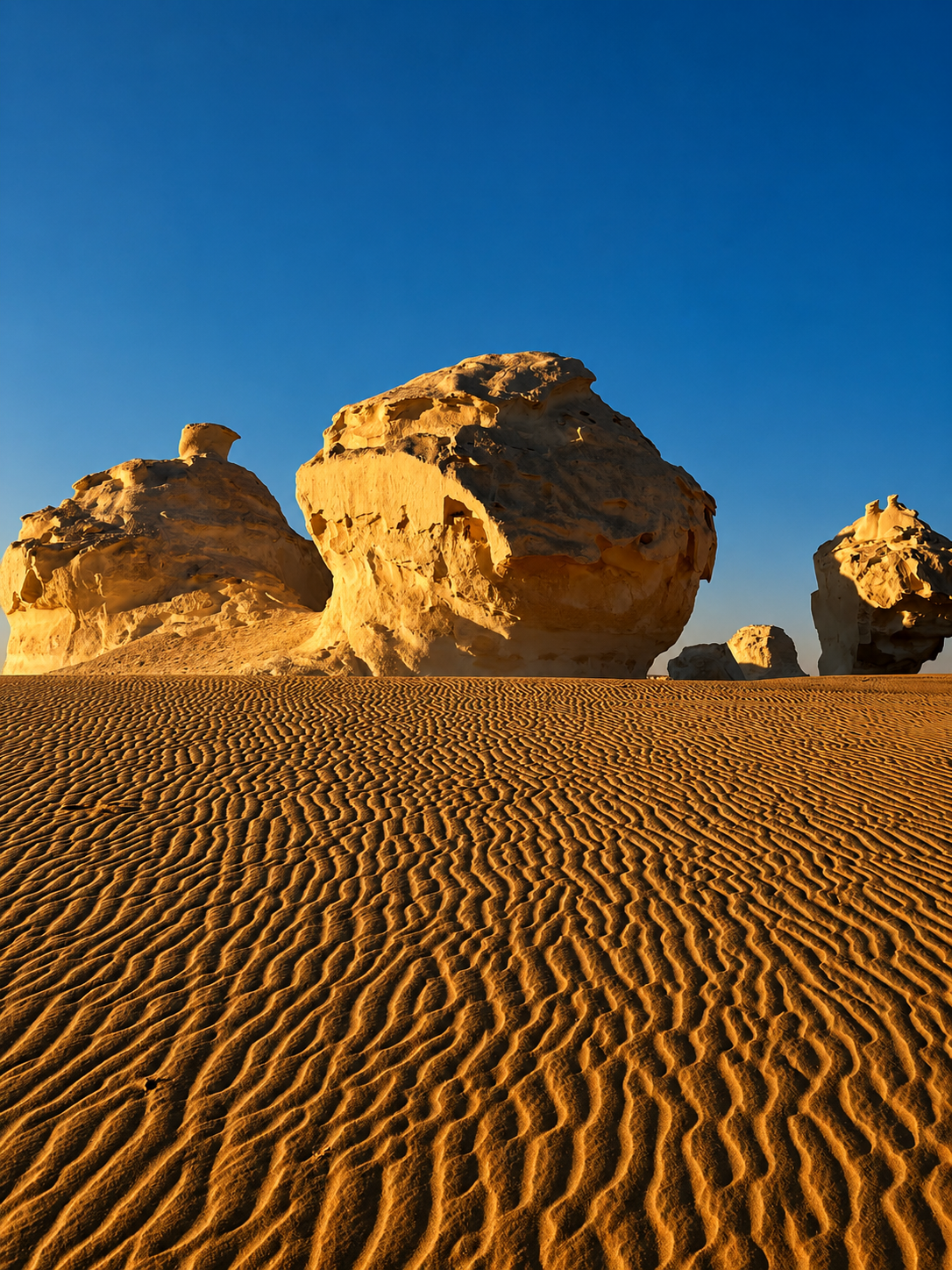
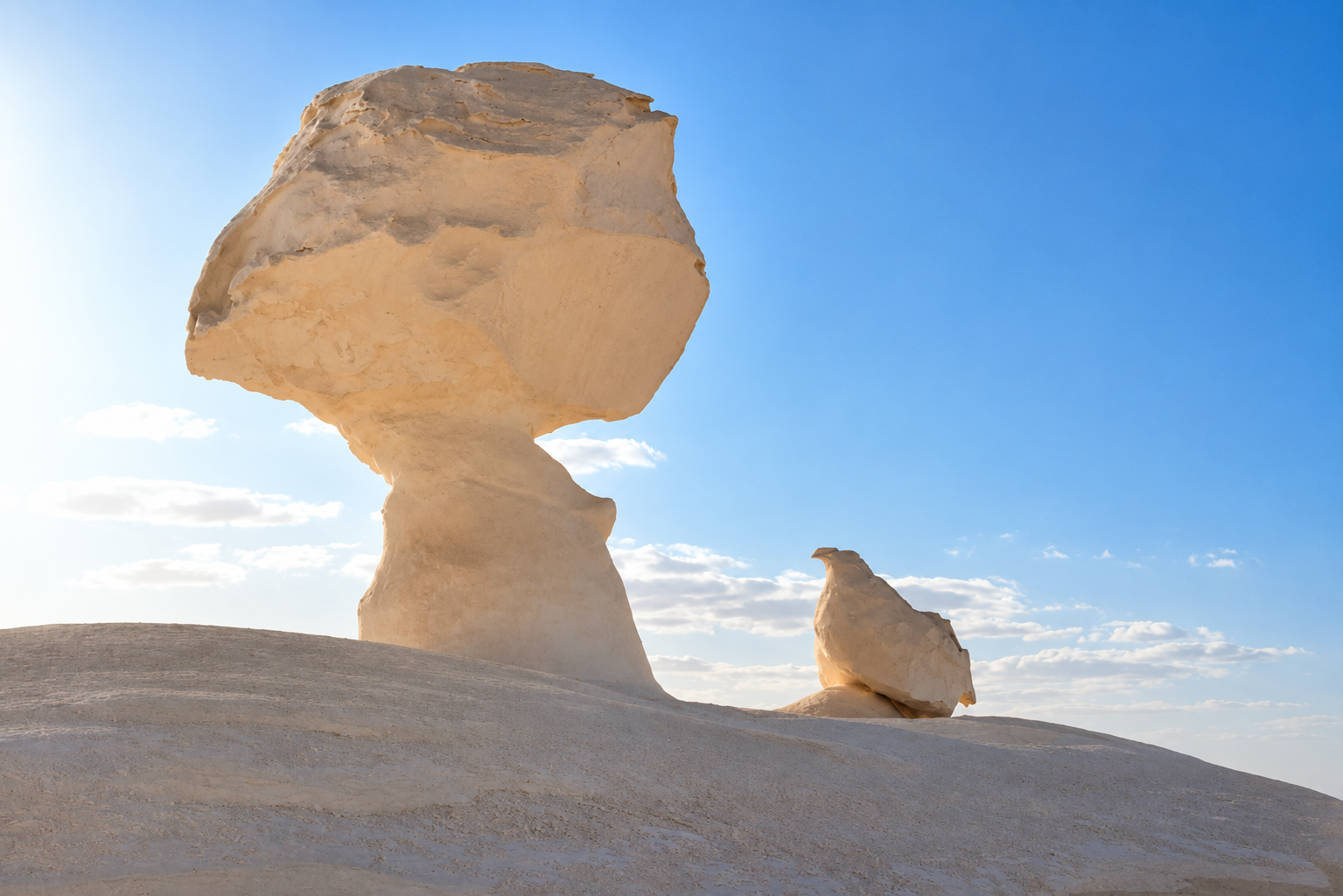
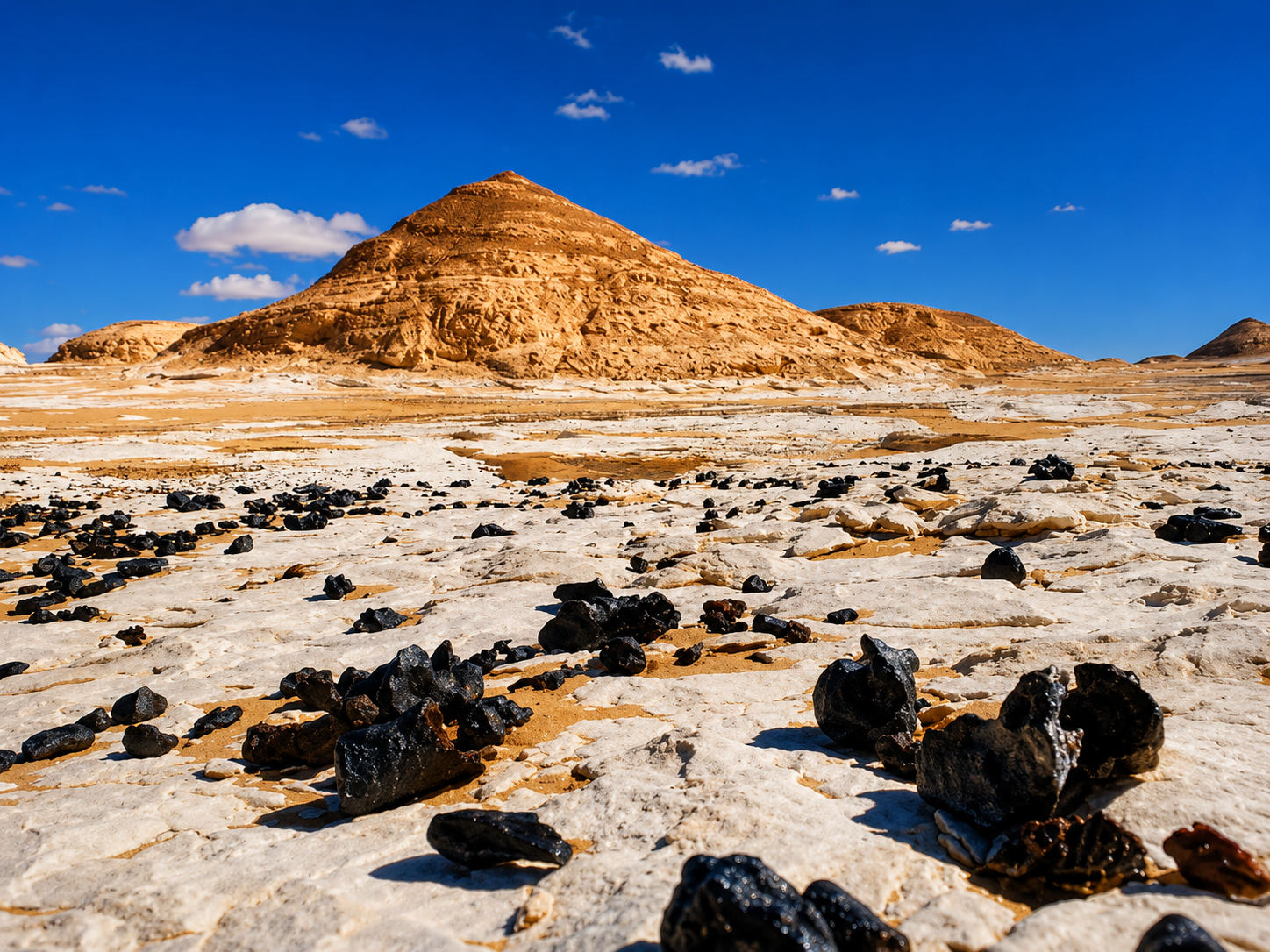
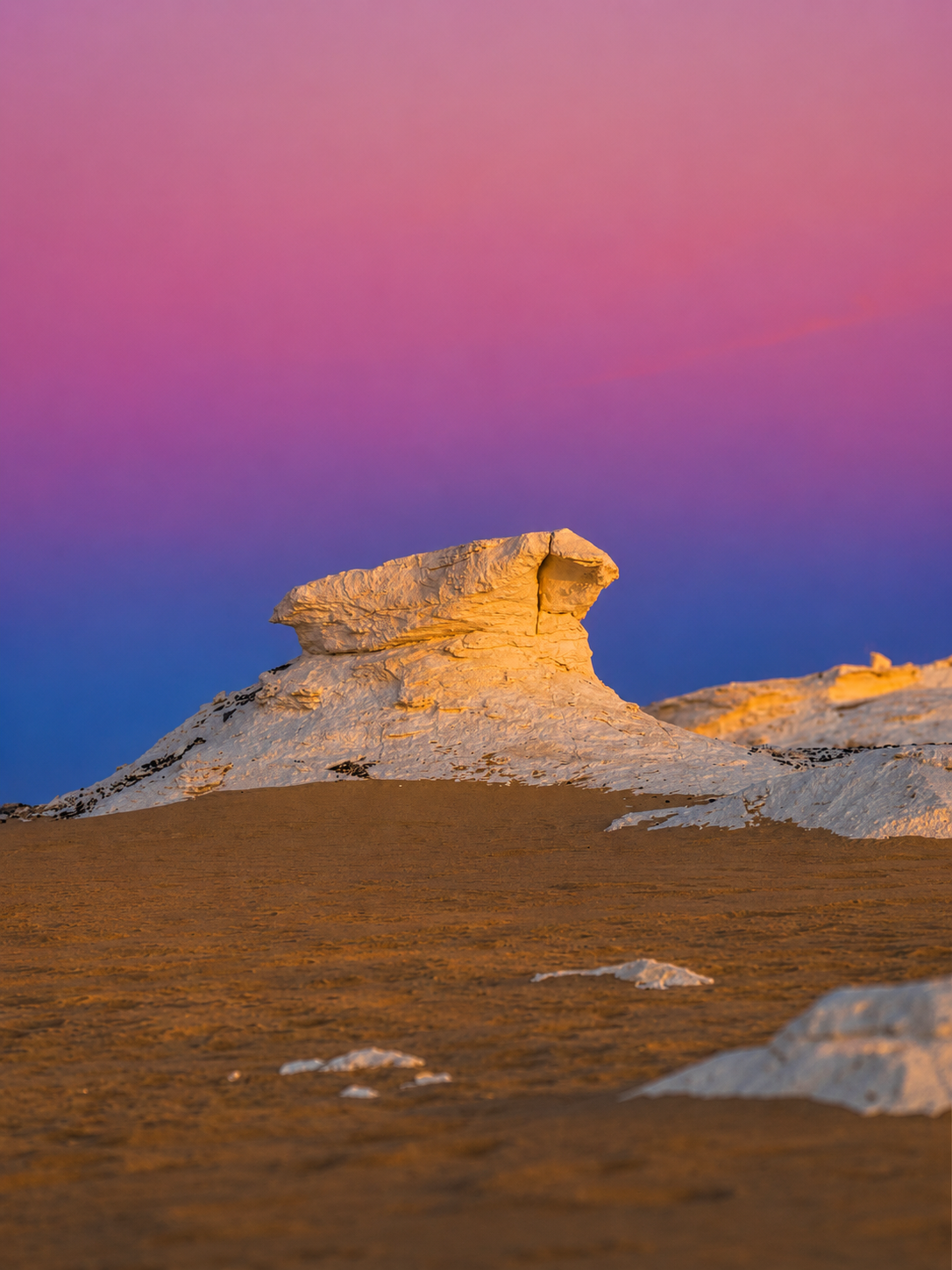
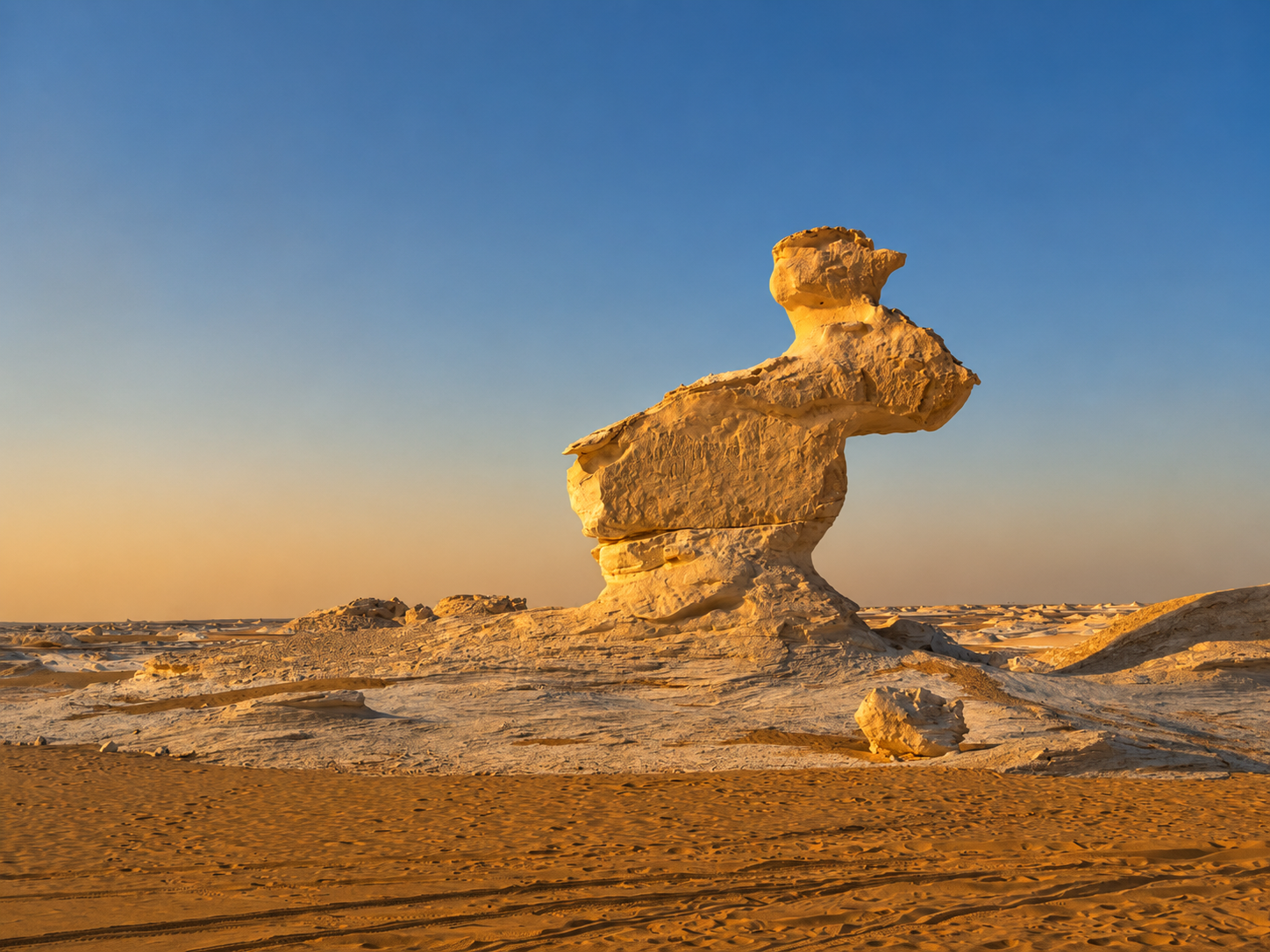
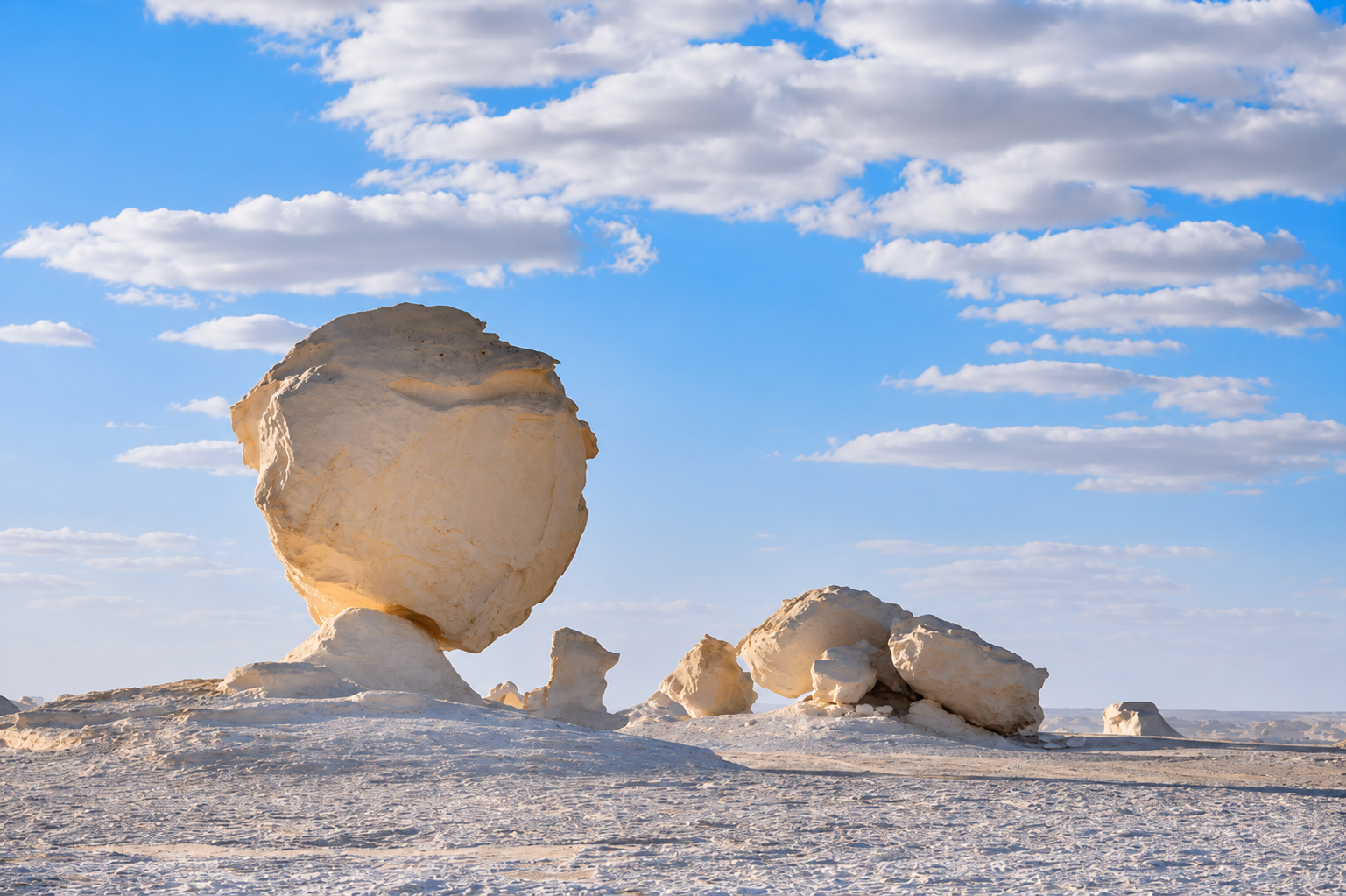
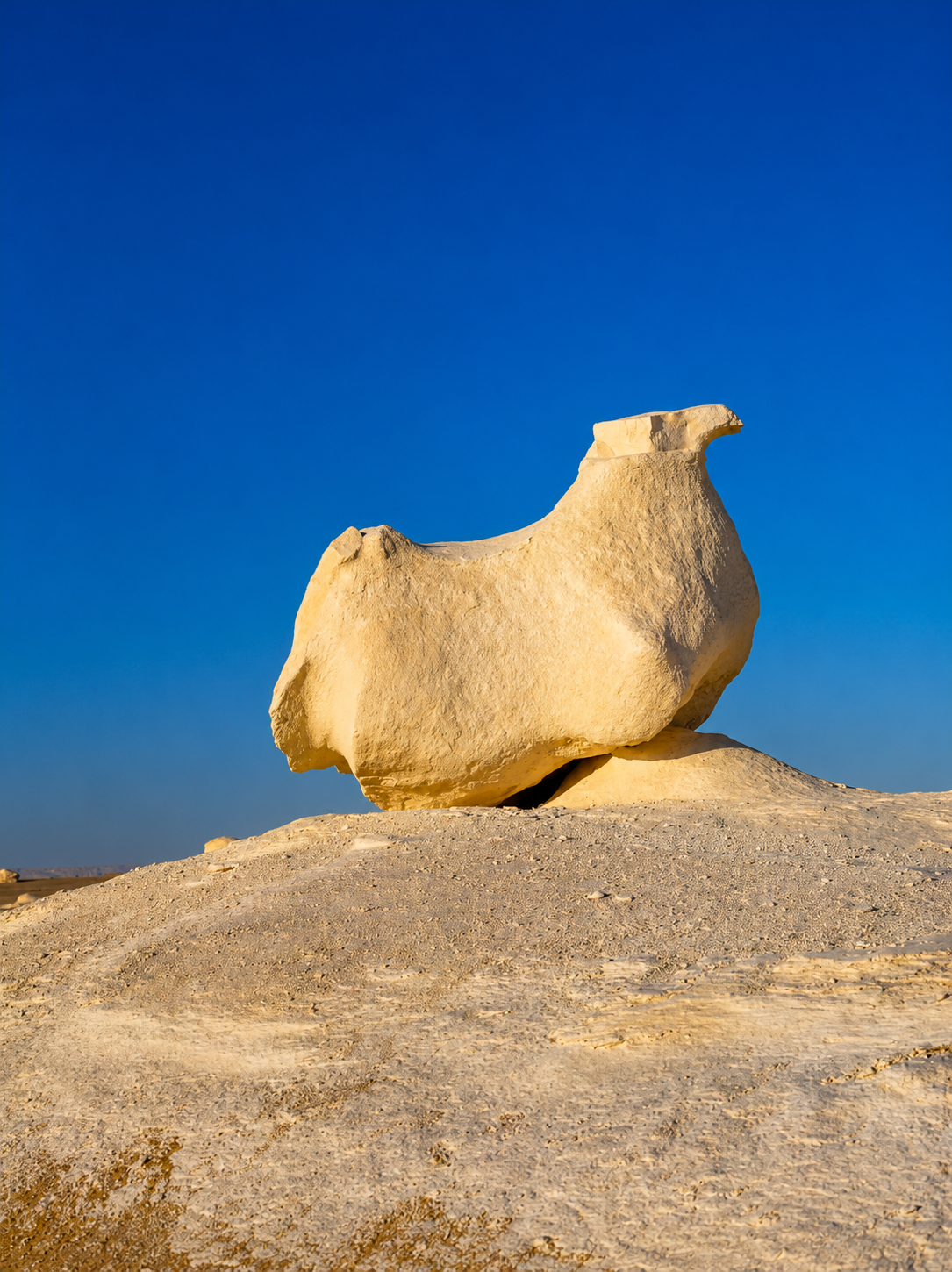
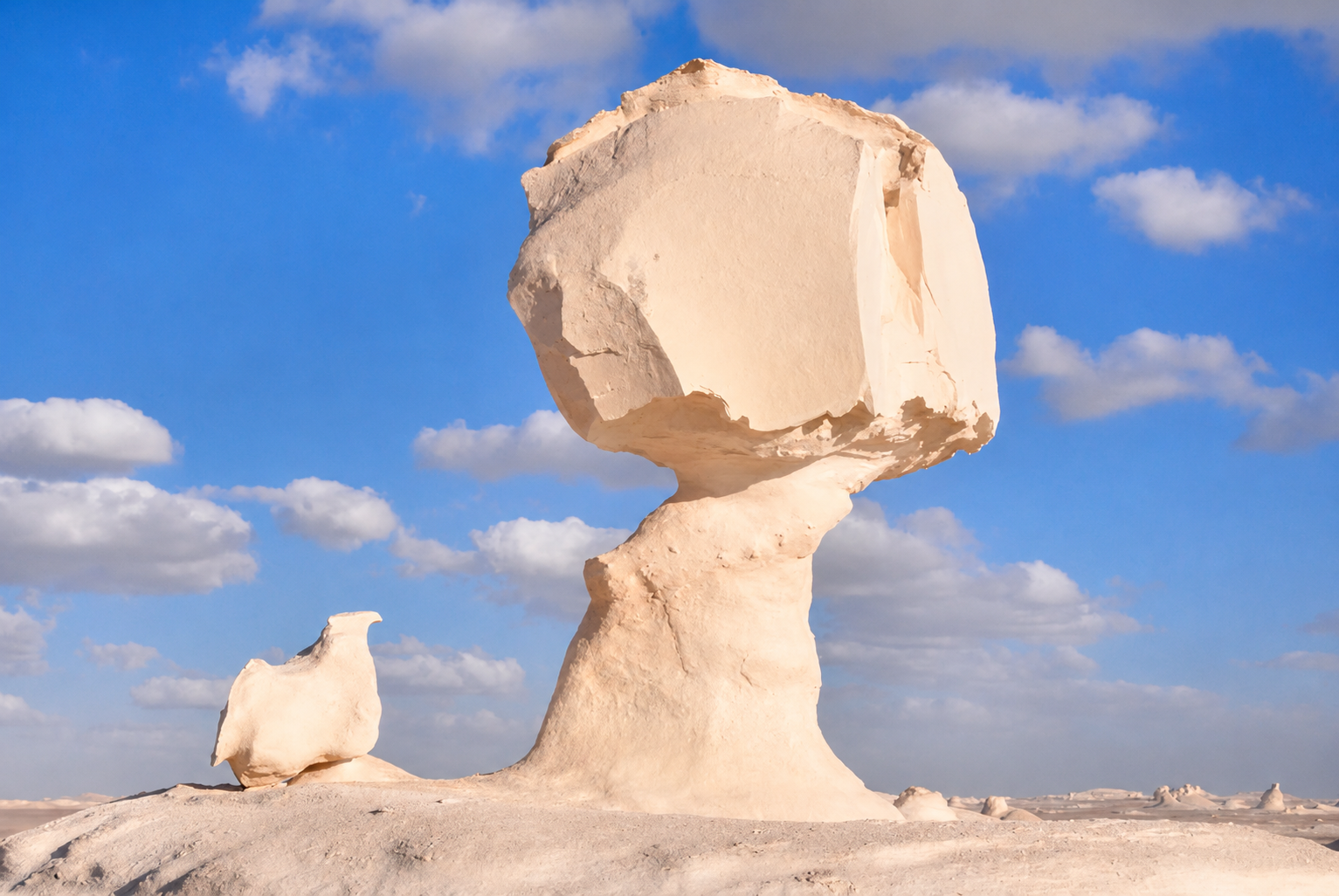
The Weiße Wüste, commonly called White Desert National Park in international travel content, is an officially protected landscape in Egypt’s Western Desert.
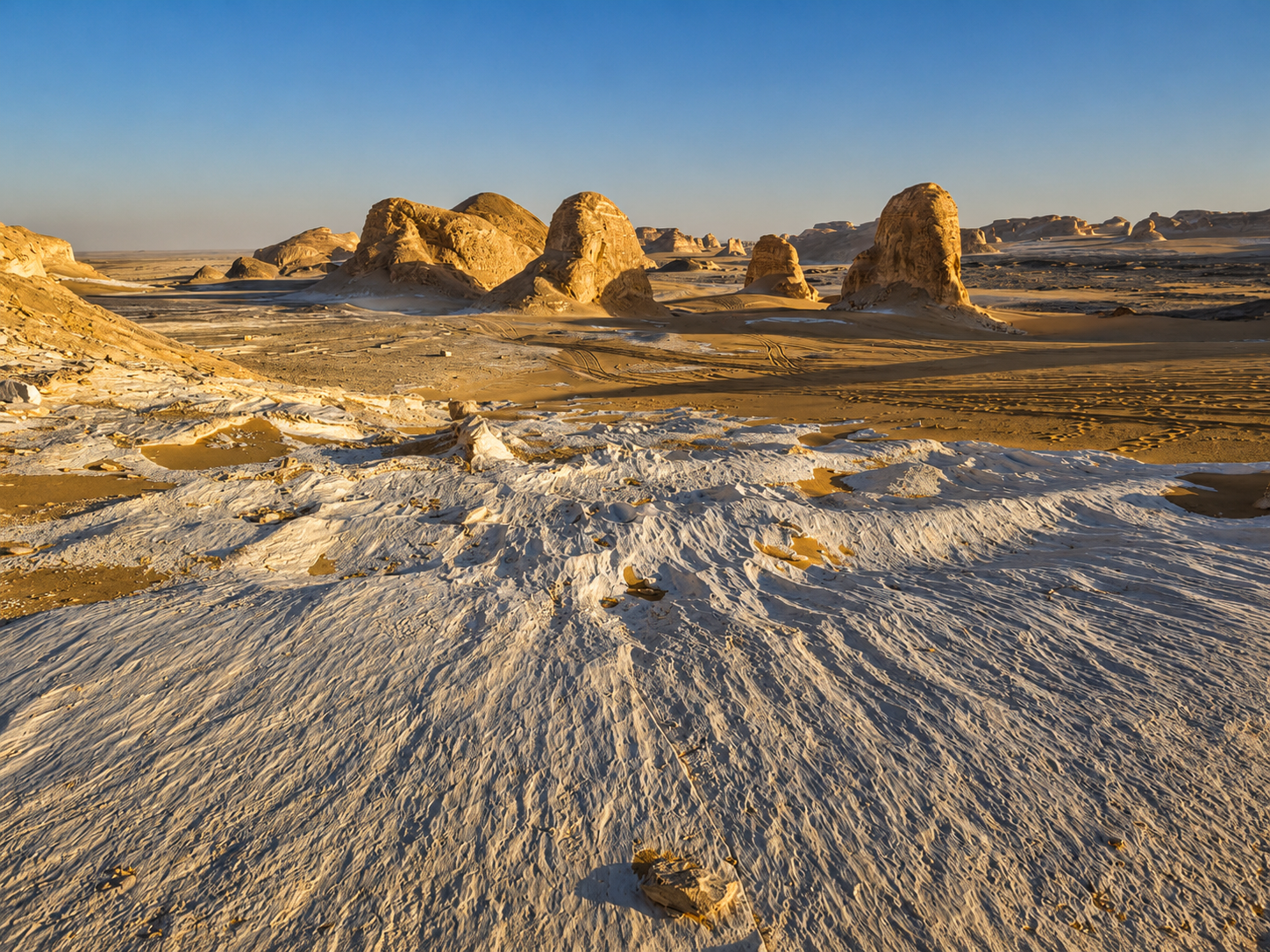
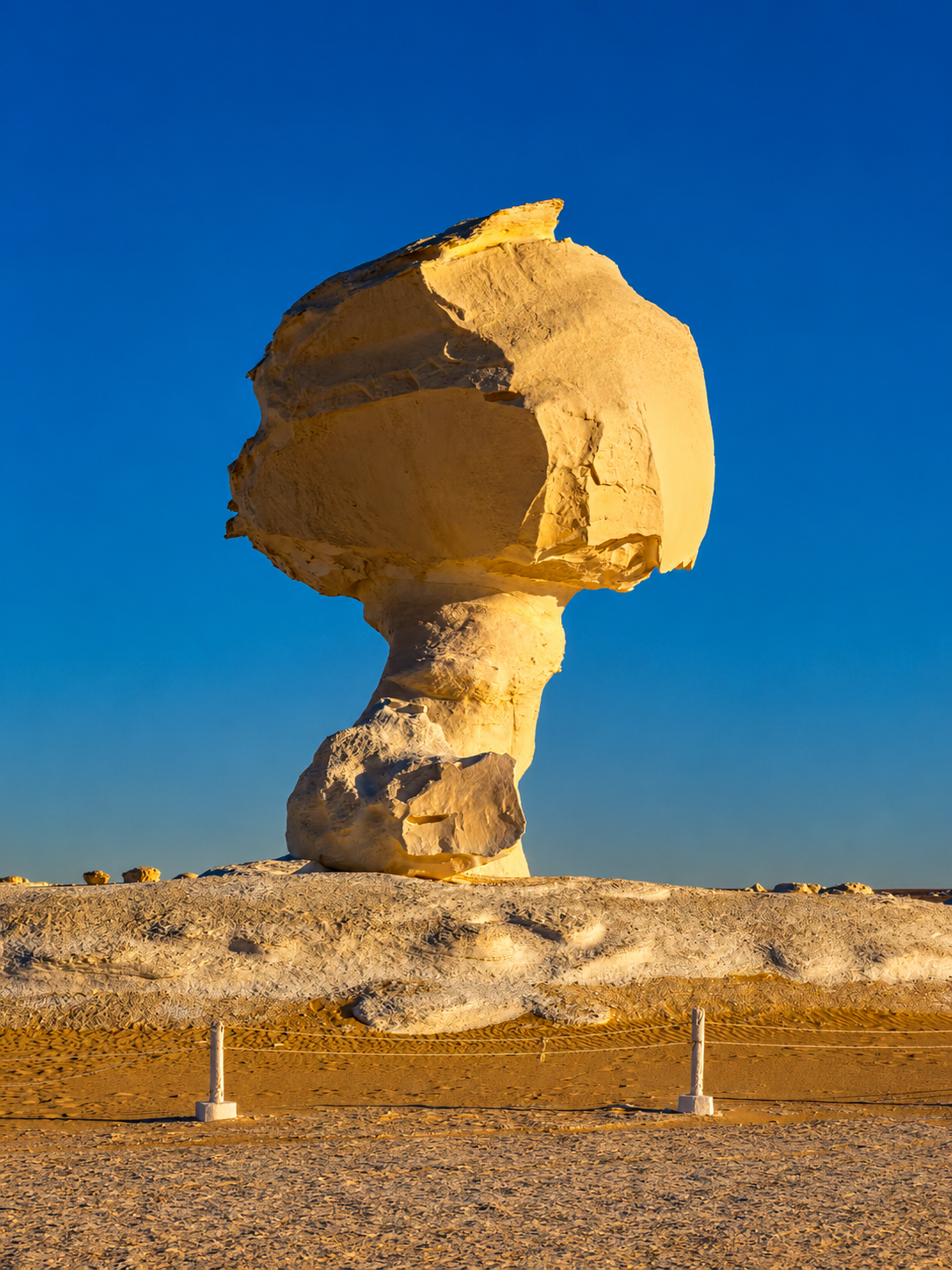
Its most recognizable feature is the enormous concentration of pale chalk and chalky limestone formations rising from the desert floor.
Some resemble giant mushrooms.
Others look like towers, domes, birds, animals or pieces of abstract sculpture.
This appearance has made the White Desert one of Egypt’s most recognizable natural destinations.
However, the landscape is more than a collection of unusual rocks.
EEAA classifies the White Desert as a Landscape Protectorate, while official management documents also use the name White Desert National Park. Its protected status reflects its geological, ecological and archaeological value.
For the protected area’s regulations, geology and conservation in more depth, read our dedicated White Desert National Park Egypt guide.
The White Desert is famous because it does not look like the desert many travelers imagine before visiting Egypt.
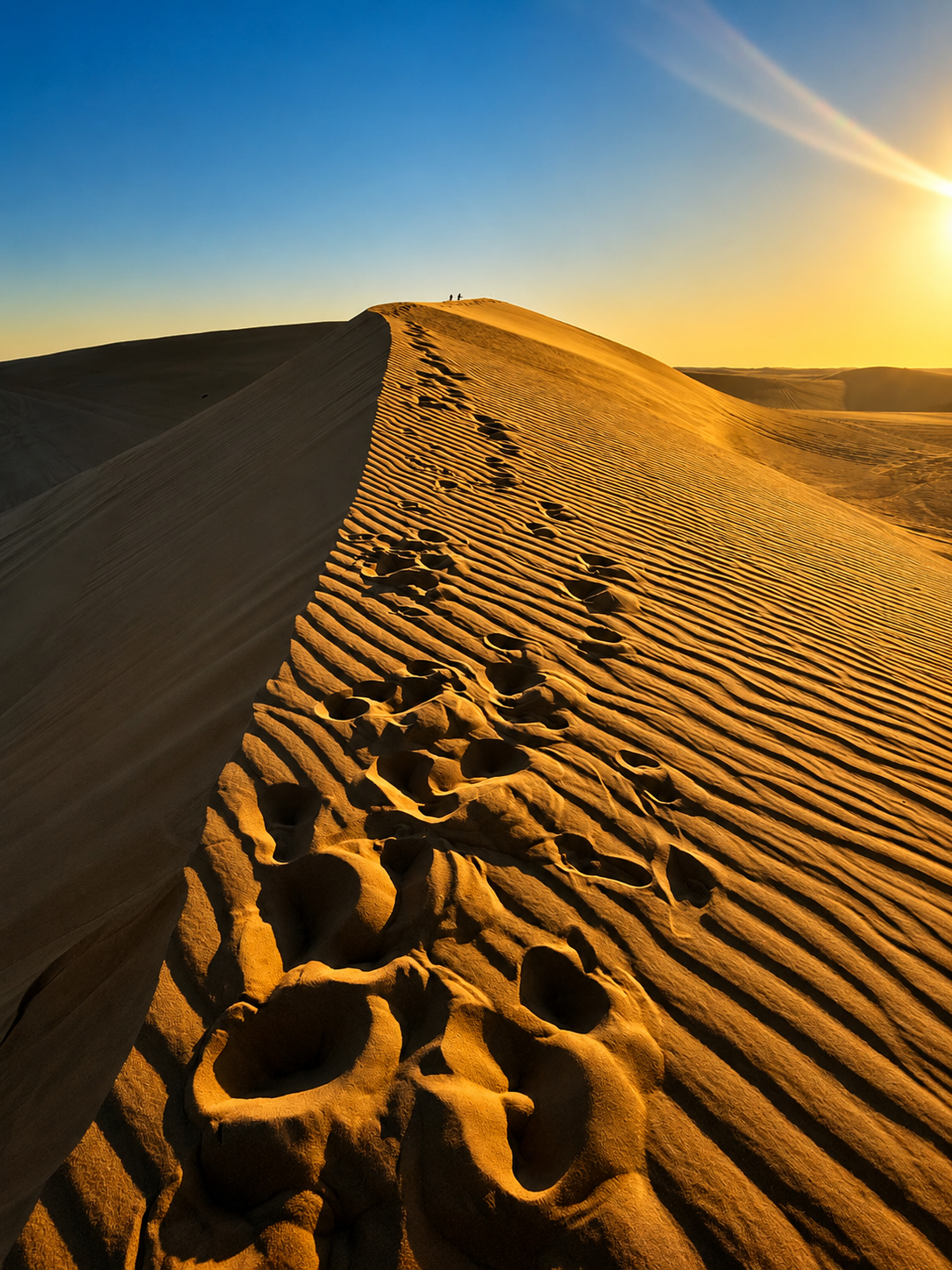
This is not simply an endless plain of golden dunes.
Instead, you encounter white chalk plains interrupted by unusual rock formations sculpted by a combination of geology, ancient karst processes and long-term erosion.
The wider route also creates dramatic contrasts.
Within the same safari you may move from:
green oasis → black hills → golden dunes → white cliffs and chalk formations.
That variety is one reason the journey itself is as important as the final destination.
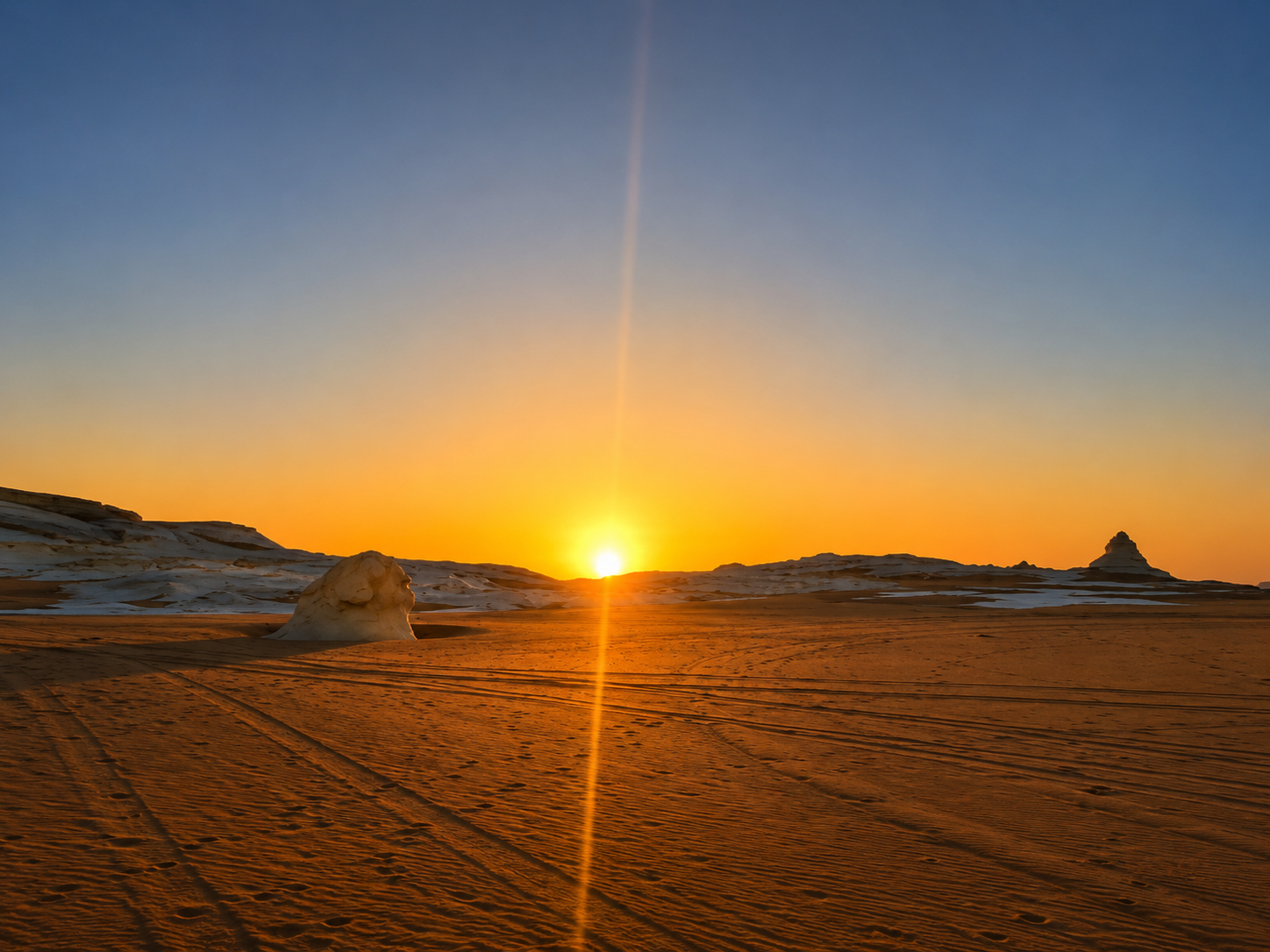
The White Desert is particularly known for its mushroom rocks, camping, sunset and sunrise, landscape photography and remote desert atmosphere.
If you want to understand exactly how these shapes formed, read White Desert Egypt Formations & Geology.
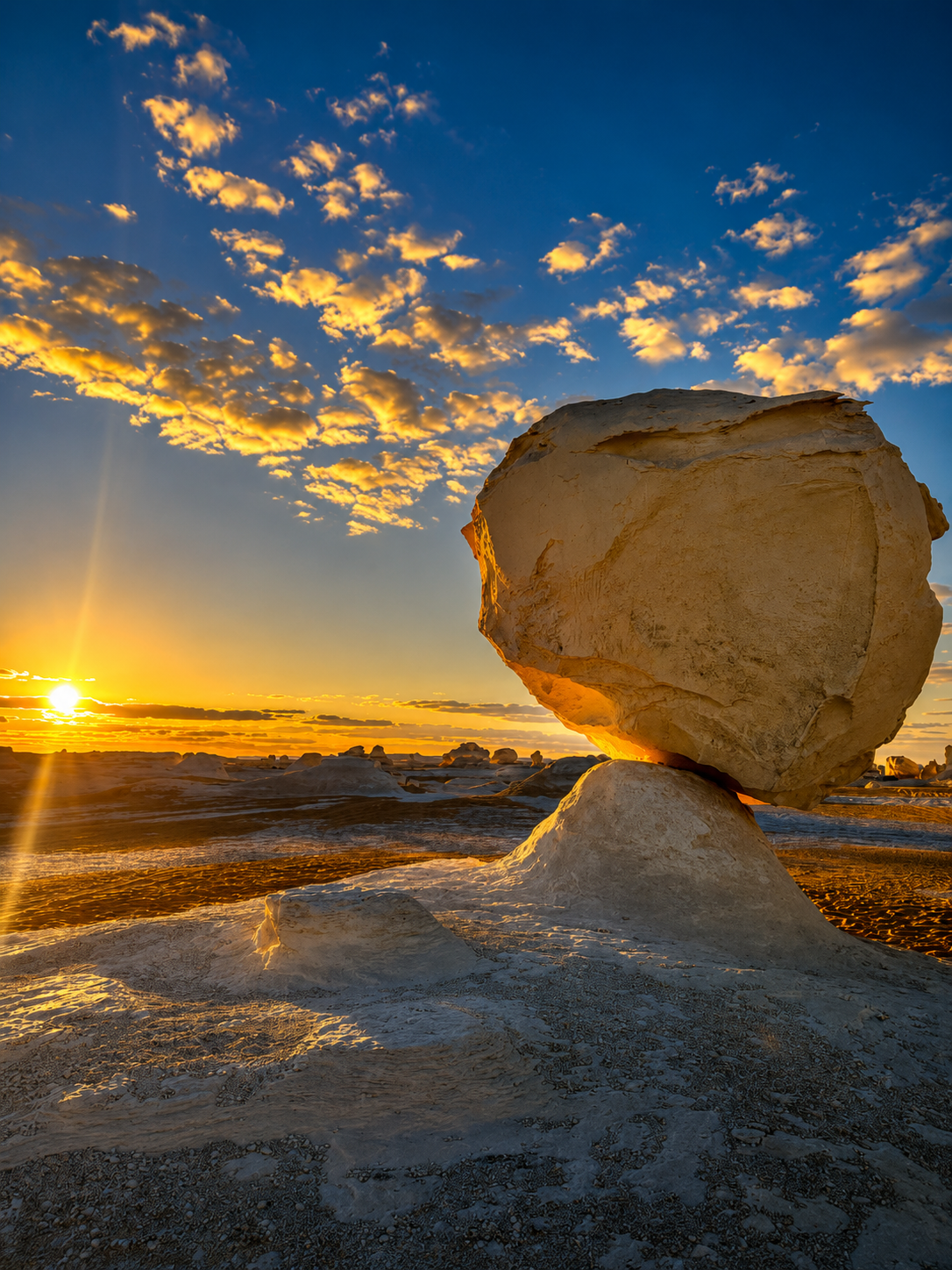
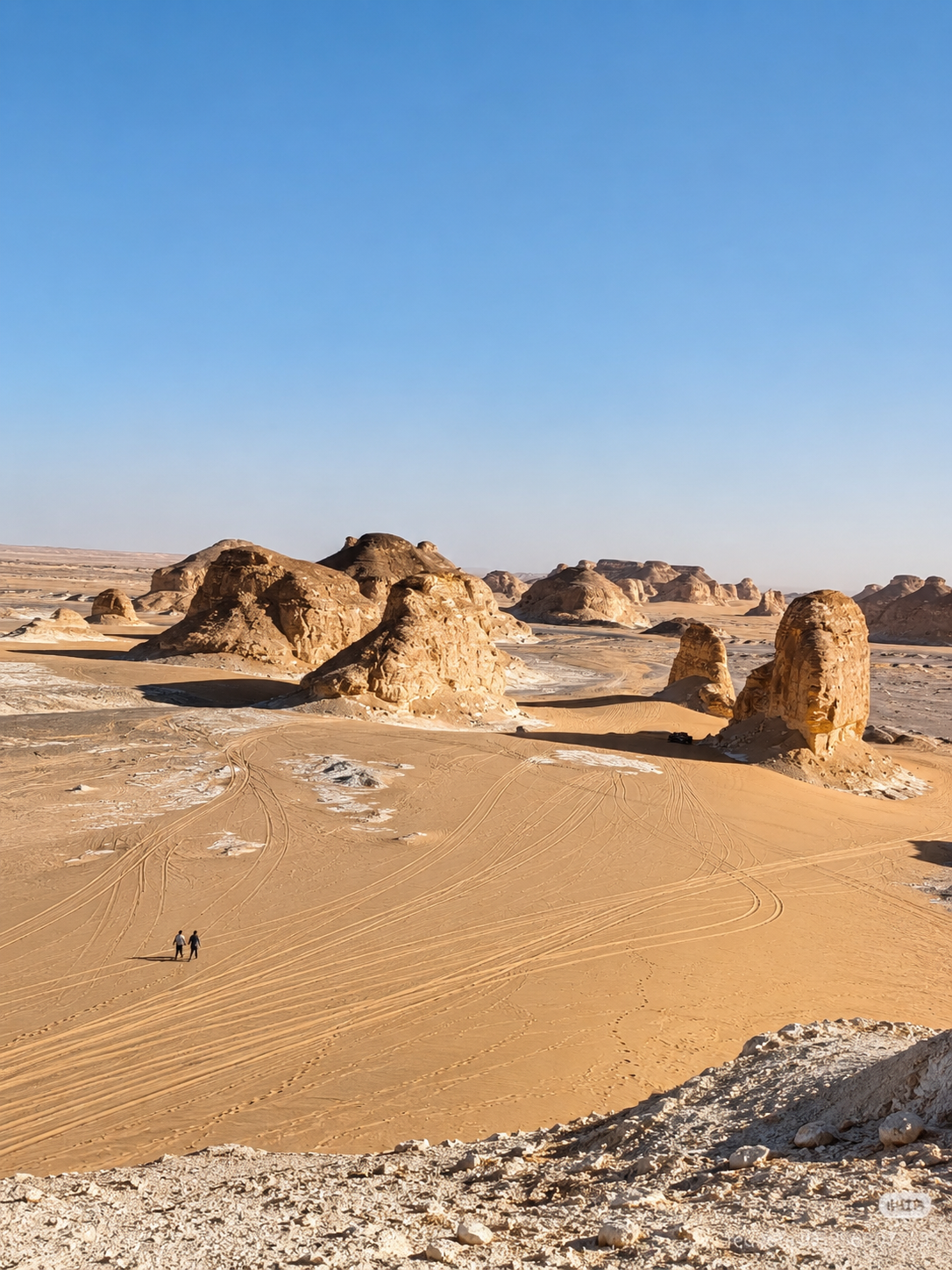
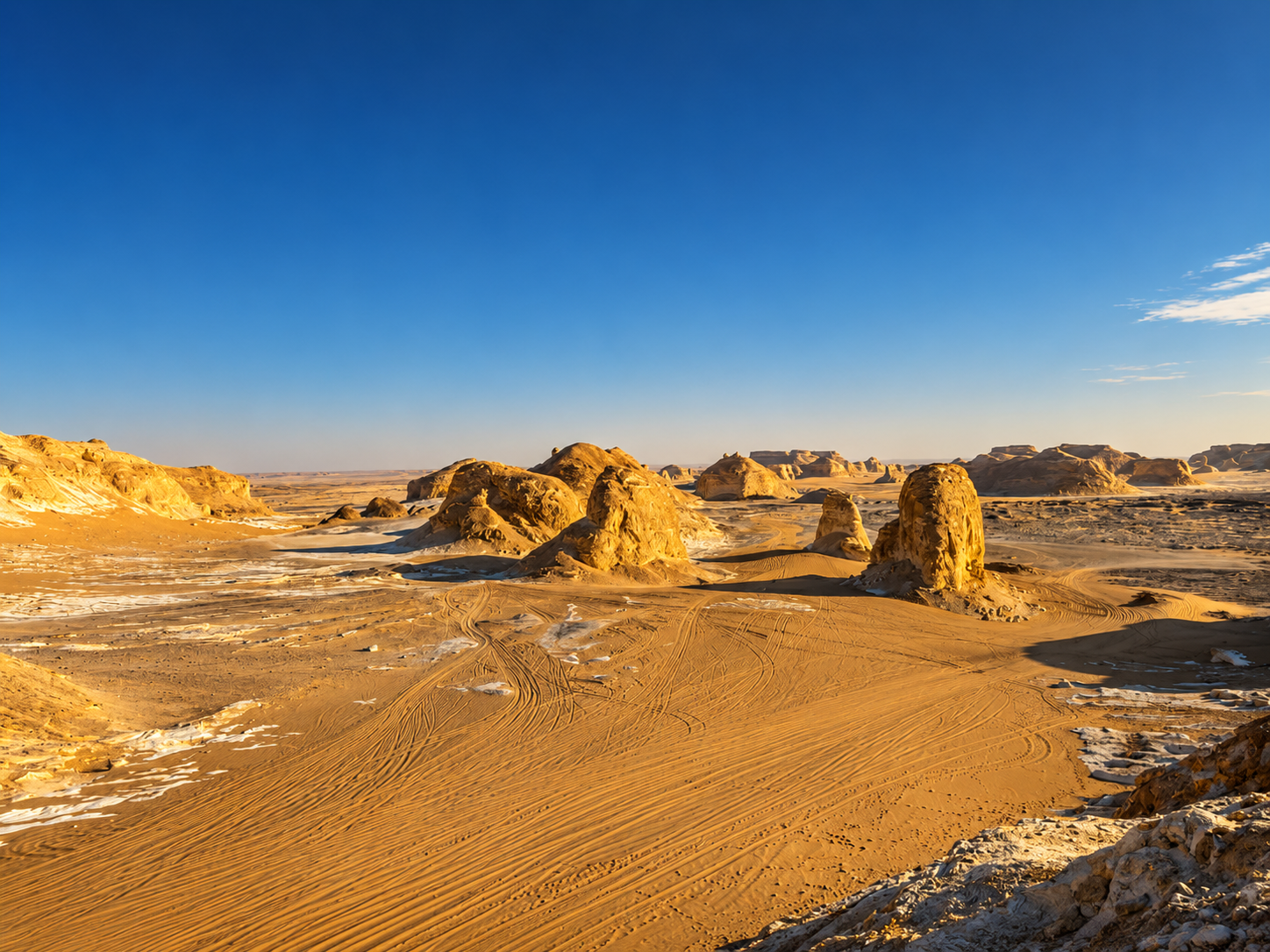
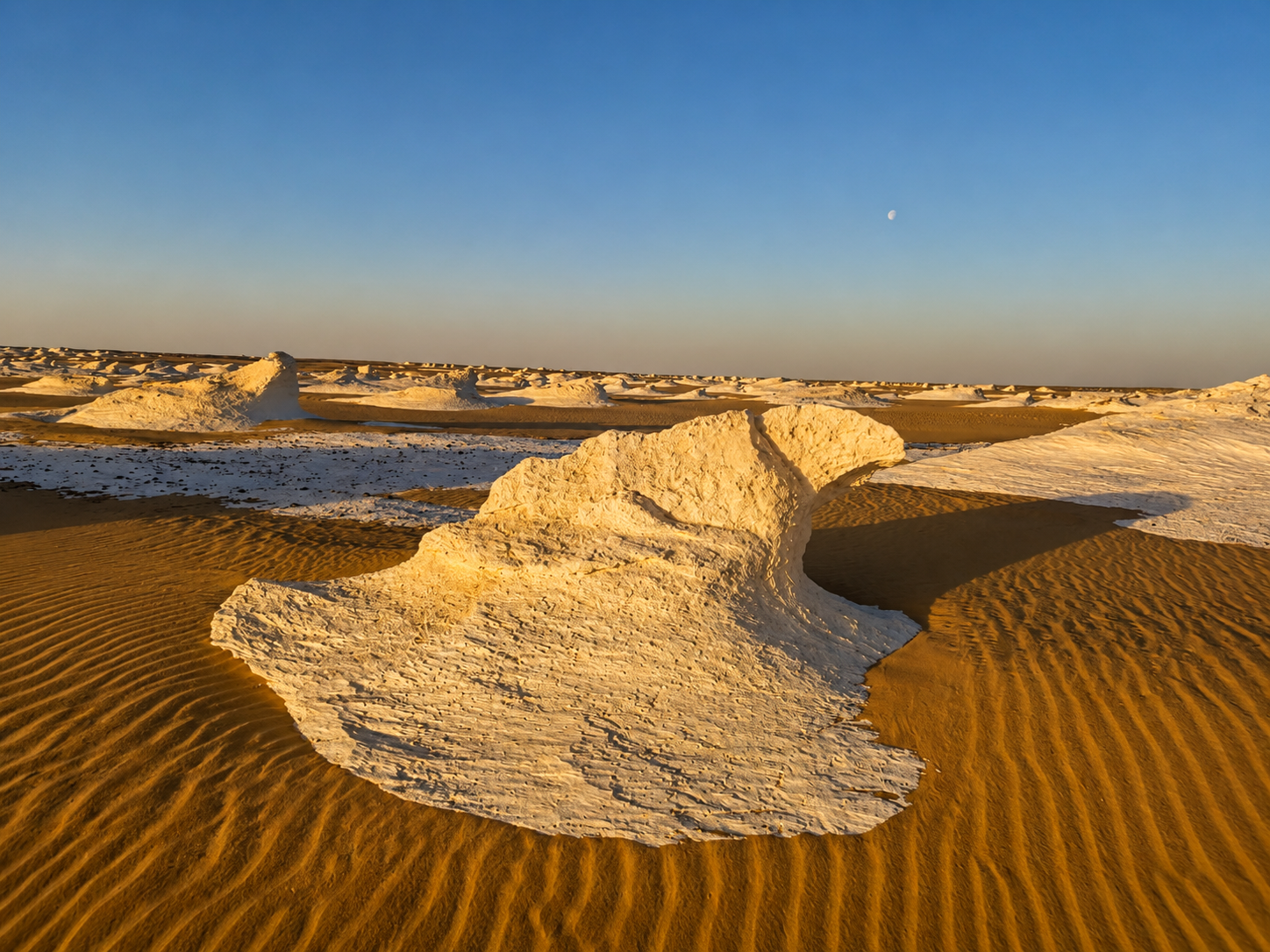
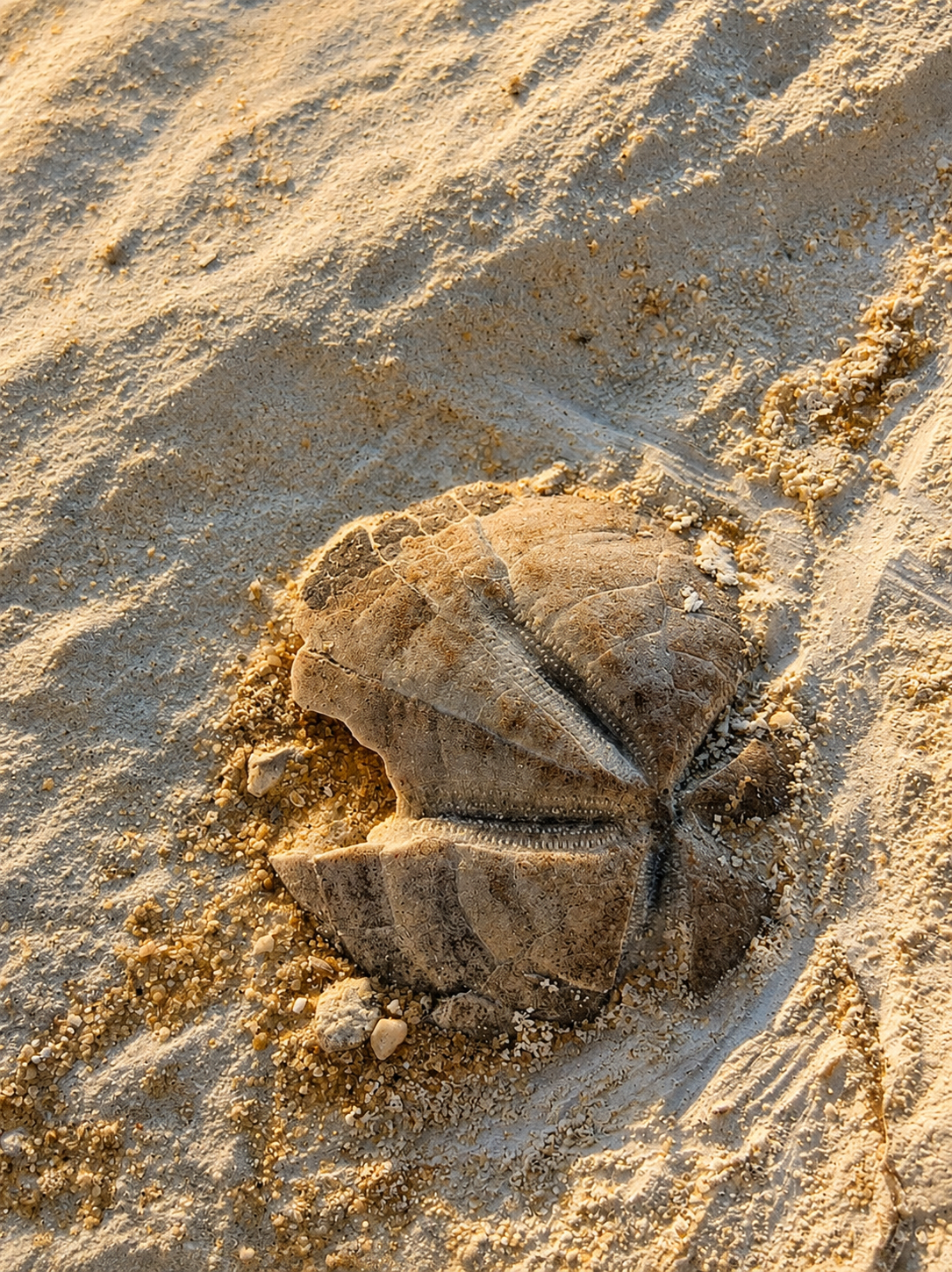
The simple explanation often repeated online is that wind carved the White Desert.
That is only part of the story.
The region contains chalk and carbonate rocks deposited in ancient marine environments. Over geological time, groundwater, fractures, karst processes, weathering and differential erosion helped shape the landscape before modern desert wind continued modifying exposed surfaces.
This explains why the White Desert contains such varied formations rather than one repeated rock shape.
Its marine origins also explain the fossils found in parts of the landscape.
EEAA describes the protectorate as an exceptional example of karst phenomena and an open-air landscape for studying geology and fossils.
The geology deserves its own article, so this main guide intentionally keeps the explanation short.
Read the complete White Desert Formations & Geology guide for mushroom rocks, chalk, marine fossils, ancient climatic phases and Crystal Mountain geology.
The White Desert lies in Egypt’s Western Desert, associated geographically with the Farafra region.
Experience Egypt places it around 40 km from Farafra Oasis.
However, travelers coming from Cairo normally approach it from the opposite direction through Bahariya-Oase.
That is why you will often see White Desert tour itineraries described as Bahariya tours even though Farafra lies closer to the protected area.
Bahariya is approximately 370 km southwest of Cairo and is the closest major Western Desert oasis to the capital.
This creates the standard tourist route:
Cairo or Giza → Bahariya Oasis → Black Desert → Crystal Mountain → Agabat → White Desert.
For a detailed transportation guide, read White Desert From Cairo.
For international travelers, organized travel with an experienced desert operator is the practical way to visit.
A normal road vehicle can take you from Cairo toward Bahariya.
The deeper off-road safari then uses a suitable 4×4.
Experience Egypt recommends specialized or licensed operators for desert exploration around Farafra, and its Bahariya information highlights the oasis as a gateway to the White and Black Deserts.
A standard journey works like this:
Early morning: pickup from Cairo or Giza.
Road journey: travel toward Bahariya Oasis.
Bahariya: lunch, rest or preparation for the safari.
4×4 section: Black Desert, Crystal Mountain, Agabat, dunes and other stops depending on the itinerary.
Late afternoon: reach the White Desert.
Abend: sunset and, on overnight tours, dinner and camping.
Next morning: sunrise, breakfast and further exploration before returning toward Bahariya and Cairo.
For most first-time travelers, I recommend spending the night.
A one-day trip is possible if your Egypt schedule simply cannot accommodate an overnight stay.
Entdecken Sie die Eintägige Tour in die Weiße Wüste ab Kairo.
The compromise is significant: much of your day is transportation, and you miss the full overnight atmosphere.
For most first-time visitors:
this is the best choice.
It allows the classic route plus sunset, dinner, camping, stars and sunrise.
Entdecken Sie die 1-Nacht-2-Tage-Tour in die Weiße Wüste ab Kairo.
This is better for photographers, campers and travelers who want the desert to feel like an expedition rather than an overnight excursion.
Explore the 2 Nächte, 3 Tage Camping-Tour durch die Weiße Wüste.
Four days give you a slower rhythm, greater off-road depth and more time around Bahariya.
Explore the 3 Nächte, 4 Tage: Tour in die Weiße Wüste ab Kairo.
For a full comparison, read White Desert Egypt Itinerary: 1, 2, 3 & 4 Days.
A White Desert tour normally includes more than the White Desert itself.
Bahariya-Oase acts as the main logistical gateway from Cairo.
Experience Egypt describes Bahariya as the Western Desert oasis closest to Cairo and highlights its palm groves, springs and surrounding natural landscapes.
The Schwarze Wüste creates the strongest visual contrast with the White Desert.
Dark stones cover hills and slopes, producing an almost volcanic appearance.
Many travelers assume White Desert and Black Desert are competing destinations.
They are better understood as two parts of the same regional safari.
Read White Desert vs Black Desert Egypt for the full comparison.
Crystal Mountain is a popular geological stop between the Black Desert and the deeper White Desert route.
Despite the name, it is not a giant mountain made entirely from crystal.
Its geology is connected to older karst and cave-related processes in the region.
Agabat combines pale cliffs, rock masses and golden sand.
For many photographers, this is one of the strongest parts of the safari.
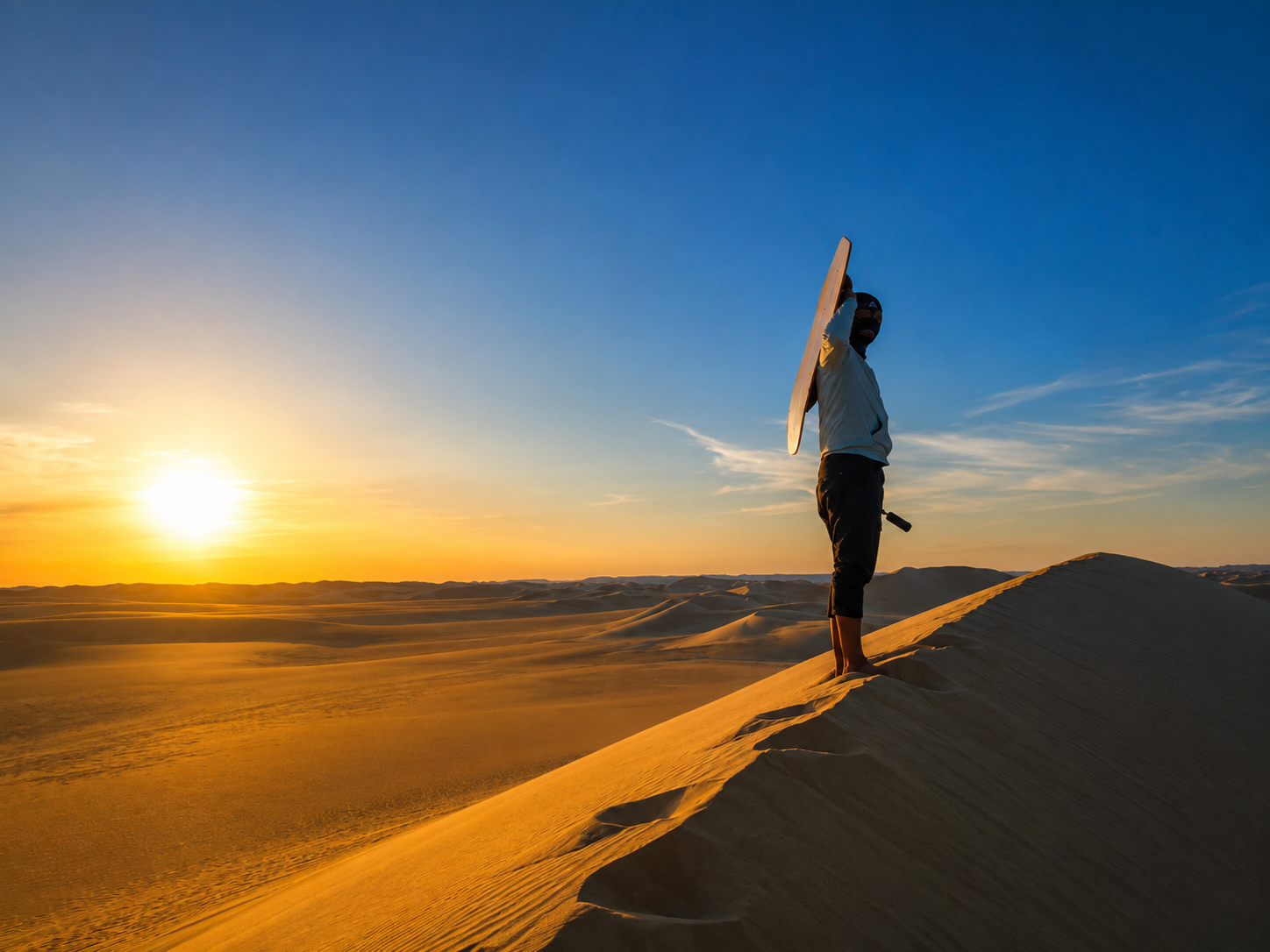
Depending on the route, dune stops may include sandboarding.
Finally, you enter the iconic chalk landscape itself.
This is where timing becomes important.
Try to remain in the region for sunset rather than rushing through during harsh midday light.
For a longer list of experiences, use Things to Do in White Desert Egypt.
Für die meisten Reisenden:
yes.
Camping is one of the main reasons I recommend two days instead of one.
During daylight, the White Desert is an extraordinary geological landscape.
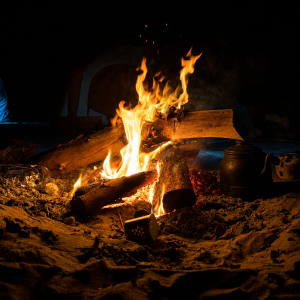
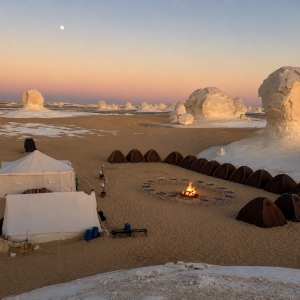
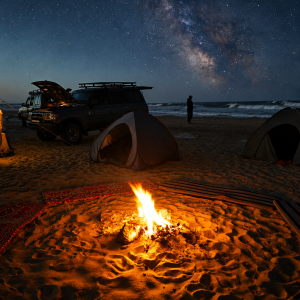
After sunset, it becomes an entirely different experience.
Vehicles stop moving.
The temperature drops.
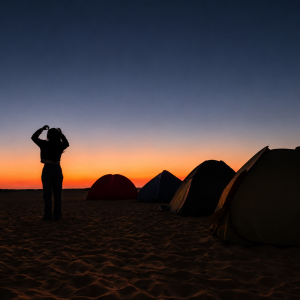
The formations turn into silhouettes.
Dinner is prepared.
The stars begin appearing.
A normal organized camp can include a tent, mattress, blankets or sleeping bag, dinner, breakfast and desert seating depending on your selected tour.
The current site’s overnight programs list camping equipment and meals as part of their packages, although exact inclusions should always be checked on the individual tour page.
Camping facilities should not be confused with a conventional hotel.
Bathrooms and washing arrangements may be basic.
That’s part of the reason travelers who require more comfort should ask detailed questions before booking.
Read our full White Desert Camping Egypt guide before choosing an overnight program.
For premium options, compare Luxury Desert Camping in Egypt.
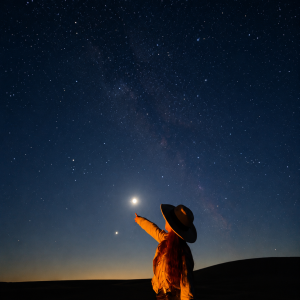
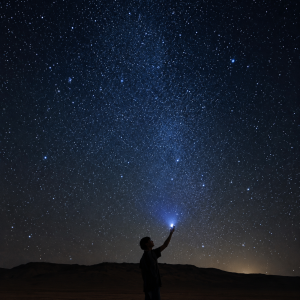
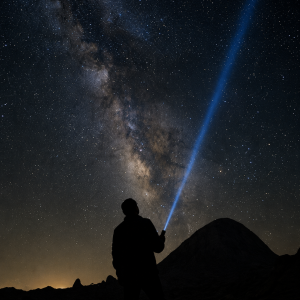
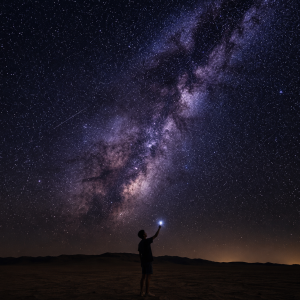
The White Desert is excellent for travelers who want to combine camping with a dark desert night.
Remote camps can experience substantially less artificial light than Cairo and other major cities.
Moon phase matters, however.
A night near new moon generally offers darker conditions for faint stars, while a bright moon can illuminate the chalk formations beautifully but wash out some of the night sky.
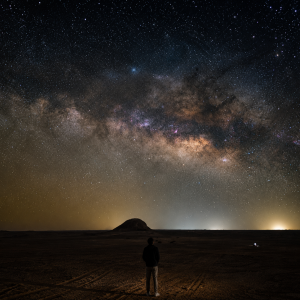
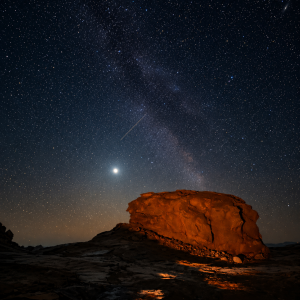
Do not assume every White Desert night automatically produces a perfect Milky Way photograph.
Weather, atmospheric clarity, moon phase and timing all matter.
For planning specifically around the sky, use our White Desert Egypt Stargazing Guide.
For most travelers, the best overall season is:
October through April.
The cooler months are far more comfortable for outdoor exploration and camping.
November through March is particularly popular.
December and January can provide excellent daytime conditions, but nights may feel cold.
October, November, February and March are especially attractive for travelers who want comfortable camping without the strongest summer heat.
Summer travel is possible under appropriate conditions, but prolonged daytime activity becomes much more demanding.
Our detailed seasonal guide covers the destination month by month:
Best Time to Visit White Desert Egypt.
For broader Western Desert seasonality, see Best Time for Egypt Desert Safari & Camping.
Current White and Black Desert Tours listings show starting rates that vary significantly by duration and itinerary.
As of September 2026, the site’s tour inventory includes the classic 2-day/1-night tour from $95, 3-day/2-night camping from $190, White Desert and Djara Cave from $250, and the 4-day White Desert tour from $290. The one-day tour is currently listed from $150.
These are starting prices, not a universal fixed rate for every booking.
Your final cost can change according to group size, private/shared arrangements, travel date, vehicle setup, pickup point and selected itinerary.
Do not choose a White Desert tour simply by finding the smallest number.
Compare:
what transportation is included,
whether the 4×4 is private or shared,
camping equipment,
meals,
fees,
guide arrangements,
and the actual route.
For the detailed price breakdown, use White Desert Egypt Cost: Tour Prices, Camping & What’s Included.
The White Desert is a managed protected landscape.
EEAA currently publishes separate White Desert categories for entry, camping and vehicle fees, and references Ministerial Decree No. 360 of 2025 on the visitor-fee page.
Fees can change, so travelers should confirm the current amount and whether it is included in the selected tour.
The park’s management plan also divides the landscape into zones.
Some strict conservation zones prohibit public vehicle access and camping, while other areas are managed for tourism and recreation.
This matters because:
private tour does not mean unrestricted access.
Your guide still needs to follow current protected-area rules.
The White Desert is remote travel, so the safety discussion should be more nuanced than saying either “completely safe” or “dangerous.”
Current UK travel advice, checked in September 2026, specifically excludes the White Desert, Black Desert, Bahariya and Farafra from its broader Western Desert warning. However, it says tourists entering these areas must arrange permits in advance and use an official guide. It also warns that phone reception and medical facilities are limited.
The same guidance currently warns against all but essential travel on the Bahariya–Siwa road.
Routes and official guidance can change.
That is why travelers should check current government advice before departure and use an experienced local operator rather than relying on an old itinerary found online.
For the detailed current discussion, read Is Egypt Desert Safari Safe?.
The White Desert should not be treated like an ordinary self-drive attraction.
Even if a road appears on a map, deeper desert travel involves more than navigation.
You need to consider:
Current official travel guidance requires an official guide and advance permits for tourists entering the White Desert area.
An organized desert trip is therefore the practical choice for most international visitors.
You do not need expedition-level luggage for a normal overnight safari.
Bring practical layers.
The most important items include comfortable closed shoes, breathable daytime clothing, sun protection, hat or scarf, sunglasses, personal medication, toiletries, phone, power bank and warm layers for night.
Winter visitors often underestimate how cold an open desert camp can feel after sunset.
Your camping equipment may already be supplied by the operator, so confirm before bringing bulky items from home.
Use the complete White Desert Egypt Packing List rather than turning this pillar into another packing article.
For the broader safari version, see Egypt Desert Safari Packing List.
If you enjoy natural landscapes, photography, camping or adventure:
yes.
The strongest argument for the White Desert is not that it replaces Cairo, Giza or Luxor.
It does not.
Its value comes from being completely different.
After several days of temples, museums and cities, the Western Desert can change the rhythm of an Egypt itinerary.
The main downsides are the long road journey from Cairo, basic camping facilities and the time commitment.
That is why the destination makes more sense on a 7–14 day Egypt trip than on an extremely short first visit.
Read the full decision guide:
Couples are particularly well suited to private overnight safaris.
The combination of sunset, dinner, stars and sunrise creates a romantic experience without needing a conventional resort.
If privacy matters, ask exactly which elements are private:
road transfer,
4×4,
guide,
camp,
tent.
Read Private Desert Safari Egypt for the private-vs-shared comparison.
Families can enjoy the White Desert, particularly when children are old enough to handle longer road travel and basic camping.
School-age children often enjoy the 4×4 ride, unusual formations, sandboarding, camp atmosphere and stars.
For very young children, Fayoum may provide an easier introduction because of the shorter journey from Cairo.
See Egypt Desert Safari for Families & Kids for the full age and destination comparison.
The White Desert is one of Egypt’s strongest landscape-photography destinations.
The best light normally comes around:
Sonnenaufgang,
late afternoon,
Sonnenuntergang,
blaue Stunde,
and night.
A private safari can be particularly valuable because photography rarely follows a rigid group schedule.
If photography is a serious priority, consider at least two nights rather than one.
Use White Desert Egypt Photography Guide for camera planning, compositions and timing.
You usually do not need to choose.
Most classic tours combine both.
The White Desert offers pale chalk formations and open white landscapes.
The Black Desert offers dark hills and black-stone-covered slopes.
Together they create one of the strongest natural contrasts in the Western Desert.
Read White Desert vs Black Desert Egypt if you want the detailed geological and travel comparison.
Choose the White Desert if you want:
a shorter 2-day trip,
Camping,
Kreideformationen,
Geologie,
stargazing.
Choose Siwa if you want:
Salzseen,
oasis culture,
Great Sand Sea,
hotel or eco-lodge accommodation,
a 3–4 day experience.
See Siwa Oasis vs White Desert for the complete comparison.
Fayoum is the stronger option when you have only one free day or want less road travel.
The White Desert is stronger for a real overnight wilderness experience.
Für die meisten Reisenden:
1 day → Fayoum
2 days → White Desert
Read Best Desert Safari From Cairo: White Desert vs Fayoum vs Siwa.
Yes, but it should not be treated as a normal Hurghada day trip.
Hurghada lies on the Red Sea side of Egypt, while the White Desert lies in the Western Desert.
The trip therefore requires a multi-day transportation plan.
For most travelers, three days is a more realistic minimum when Hurghada is the true starting point.
Read White Desert Tour From Hurghada for route options, durations and how to connect Hurghada with the standard Bahariya safari.
Ja.
Instead of returning to Cairo, longer Western Desert routes can continue south through the oases toward Luxor, subject to current route access and permit arrangements.
Two useful options are:
White Desert Tour From Cairo to Luxor
und
White Desert Tour From Luxor to Cairo.
For travelers wanting Dakhla as part of the route, see:
3 Days Cairo, Luxor, White Desert & Dakhla.
Current route advice should always be checked before a multi-oasis itinerary.
Instead of choosing by price alone, choose by the experience you actually want.
One Day White Desert Tour From Cairo
Choose this only when an overnight stay is impossible.
1 Night 2 Days White Desert Tour From Cairo
For most travelers, this is the strongest combination of travel time, cost and experience.
2 Nächte, 3 Tage Camping-Tour durch die Weiße Wüste
Ideal for photographers and travelers who want deeper off-road exploration.
3 Nights 4 Days White Desert Tour From Cairo
Best when the desert is one of the main parts of your Egypt trip.
White Desert & Bahariya Oasis Tour From Cairo
Useful for travelers wanting more oasis time and a mixed camp/hotel style trip.
White Desert & Djara Cave Tour From Cairo
A stronger choice for travelers specifically interested in caves and deeper Western Desert exploration.
A simple decision works well.
Only one day?
Choose the one-day safari.
First visit?
Choose 2 days / 1 night.
Love camping or photography?
Choose 3 days / 2 nights.
Want slow travel and deeper desert exploration?
Choose 4 days.
Want more oasis culture?
Combine Bahariya with the White Desert.
Want a specialized expedition?
Add Djara Cave.
Traveling between Cairo and Luxor?
Use the desert as part of the overland route rather than returning to your starting city.
The White Desert should remain extraordinary for future travelers.
That requires treating it as a protected geological landscape rather than an outdoor theme park.
Do not collect fossils, crystals or pieces of chalk.
Do not damage or climb fragile formations.
Do not leave plastic, wipes or other rubbish.
Do not drive away from established or approved routes simply for a photograph.
Follow your guide’s campsite instructions and current protected-area regulations.
EEAA’s management framework exists precisely to balance visitor access with conservation.
Responsible travel is not separate from the White Desert experience.
It is part of it.
White and Black Desert Tours focuses on Western Desert journeys including the White Desert, Bahariya, Black Desert and longer oasis routes.
A White Desert trip requires more than simply booking a vehicle.
The experience depends on:
route planning,
4×4 logistics,
camp equipment,
meals,
timing,
current permits,
and local desert knowledge.
Private arrangements can also give couples, families and photographers greater control over stops and pace.
When requesting a tour, send your:
travel date, number of guests, starting location and preferred duration.
That makes it much easier to recommend the correct program rather than simply selling the longest itinerary.
WhatsApp: +20 10 05014595
Explore White Desert & Egypt Tours
Kontaktieren Sie White and Black Desert Tours
If this is your first White Desert Egypt trip and you can spare two days:
book one night.
The classic route from Cairo through Bahariya, the Black Desert, Crystal Mountain and Agabat already provides enormous variety.
But sunset, camping, darkness and sunrise are what turn the journey into a complete experience.
One day is possible.
Three days are richer.
Four days allow deeper travel.
But for the average first-time visitor:
2 days / 1 night is the sweet spot.
Plan the trip during the cooler months when possible.
Pack warm layers.
Use experienced local guides.
Check current route advice.
Respect the protected landscape.
And treat the White Desert as more than a collection of Instagram rock formations.
It is one of Egypt’s most unusual geological landscapes and one of the strongest ways to experience the country beyond the Nile Valley.
For the wider desert-planning cluster, continue with Egypt Desert Safari, Ägypten Desert Camping und Egypt Desert Safari With Camping.